Contents
- Many names for one flatbread
- Baking day: where it all begins
- What the old sources really tell us
- Alsace, Baden, Palatinate: whose dish is it?
- From the farm to the restaurant
- Classics and variations
- Tarte flambée and pizza: siblings, not twins
- The dough: bread dough then, often yeast-free now
- What remains of baking day
Paper-thin, crisp at the edges, spread with soured cream, onions and bacon, and out of the hot oven in a minute or two. Tarte flambée is one of the most honest dishes there is, and so is its history. It does not play out in palaces or famous restaurants but on farms, on baking day, in front of the wood-fired oven. That is exactly why it is poorly documented, and why it pays to look closely at what we actually know and what is only told.
Many names for one flatbread
Along the Upper Rhine, almost every corner has its own word for it:
- Flammekueche is the Alsatian name.
- Tarte flambée is the French name. Literally that means "flamed tart", but nothing is set alight. The name comes from the flames in the oven, not from alcohol. The French travel guide Routard puts it neatly: it is more "flammée" than "flambée".
- Flammkuchen is the German word. The Duden dictionary marks it as regional and also lists the form "Flammenkuchen".
- In Upper Swabia people know the Dinnete, sometimes called the "Swabian pizza" - a close cousin made from bread dough, usually smaller and with a heartier flour.
There are plenty more dialect names in Baden, Switzerland and Swabia for thin, topped flatbreads from the bread oven. Not all of them mean exactly the same dish, and we could not find reliable sources for all of them, so we stick to the well-documented names here.
Baking day: where it all begins
To understand tarte flambée, picture a farm a hundred or two hundred years ago. Bread was not bought fresh every day but baked at home, in the farm's own oven or in the village bakehouse. According to Alsace's tourism board, farmers in the Kochersberg used to bake bread only every two or three weeks. Baking day was an occasion, often shared with neighbours and farmhands.
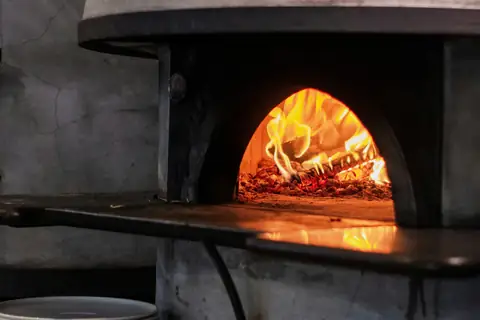
A wood-fired bread oven works like this: you fire it with wood for a long time until the masonry is hot right through. Then the embers are raked out or pushed aside and the loaves go in. At first, though, the oven is far too hot for bread, which would burn on the outside before it was cooked inside.
The traditional explanation: a heat test
This is where the best-known explanation for tarte flambée comes in:
This story is not plucked from thin air. The Basel folklorist Albert Spycher points to the Rhineland dialect dictionary (Rheinisches Wörterbuch), which records exactly such a custom from Saarland and Rhineland-Palatinate: while the wood fire still burned at the back of the oven, the embers at the front were swept aside and the flame cakes baked there. If they turned out well, that was taken as a sign of the right baking temperature. The same tradition gives a practical reason too: the flame cakes were a quick meal until the loaves had cooled, because people back then were not supposed to eat bread warm from the oven.
The important caveat: this is oral tradition, written down in dialect dictionaries. There is no date for "the first tarte flambée". Spycher states plainly that you will search in vain for historical baking instructions for it.
A second version: the leftover dough
Alsace's tourism board tells the story a little differently: when the bread was done, the leftover dough was topped with cream, onions and bacon and baked, "and that's where the tarte flambée comes from". According to the Luxembourgish dictionary, people in the Moselle area likewise made a "Flamekuch" from scraped-together dough scraps.
The two versions do not contradict each other. Depending on the farm, the village and the area, people probably baked it before the bread, after the bread or in between. What every version shares is that tarte flambée is a child of bread baking, made from bread dough and whatever the farm had to hand: cream or fresh curd cheese (Alsatian "Bibeleskäs"), onions, bacon.
What the old sources really tell us
Because tarte flambée was everyday food, hardly anyone wrote it down for a long time. There are a few traces all the same, and they show how old the family of thin bacon and cream flatbreads on the Upper Rhine is:
| Year | Source | What it says | What it means |
|---|---|---|---|
| 1550 | Hieronymus Bock, "Teutsche Speißkammer" | "Flam Kuchen in nöten", an emergency bread baked on hot stones or in ashes | The word is old, but it refers to emergency bread, not our topped tarte |
| 1591 | Cookbook of Magdalena Platter, Basel | Flat bacon tart on rolled-out dough | An early relative from the town kitchen |
| 1811 | Margarethe Spoerlin, Upper Rhine cookbook, Mulhouse | Yeast-dough bacon tart baked after the bread | Baking in the residual heat after the bread is documented |
| 20th c. | Rhineland and Luxembourgish dictionaries | Flame cakes as a heat test and from dough scraps | The baking-day tradition is recorded in dialect |
| 1960s on | Restaurants | Tarte flambée becomes a restaurant dish | The move from farm to menu |
None of these sources draws a straight line to today's tarte flambée, but they do show the setting: thin, topped flatbreads from the bread oven had been known on the Upper Rhine for centuries.
Alsace, Baden, Palatinate: whose dish is it?
The honest answer: a bit of everyone's. Over the centuries Alsace changed hands between France and Germany several times, and food has never respected borders. Farmers on both banks of the Rhine had the same ovens, the same ingredients and similar customs.
In Alsace it is above all the Kochersberg, a fertile hilly area northwest of Strasbourg, that claims to be the birthplace. Daniel Vierling, president of the "Confrérie du Véritable Flammekueche", a brotherhood dedicated to the traditional dish, told National Geographic that the Kochersberg farmers created it to test the heat of their ovens.
On the German side, Flammkuchen is at home in Baden, the Palatinate and Saarland, and the dialect-dictionary tradition quoted above comes precisely from Saarland and Rhineland-Palatinate. With the Dinnete in Upper Swabia there is a close relative even further east. So anyone who claims it is "purely Alsatian" or "really German" is making things too simple.
From the farm to the restaurant
For a long time tarte flambée was food for baking day and village festivals. According to National Geographic, some innkeepers in the region were already serving it in the 19th century. Its big breakthrough, however, came in the 1960s, the same time pizzerias were becoming fashionable. A thin, topped flatbread from a hot oven fitted the mood of the era perfectly.
Exactly how it spread through Strasbourg and other towns at that time, which restaurant was first and in which year, is not well documented. Rather than invent a nice founding story, we leave it at that.
Today tarte flambée is a fixture of winstubs, wine festivals, street fairs and markets on both sides of the Rhine. And it has travelled far beyond the region: you will find it all over Germany, in the supermarket freezer as well as fresh from the wood-fired oven at a market stall.
Classics and variations
The classic
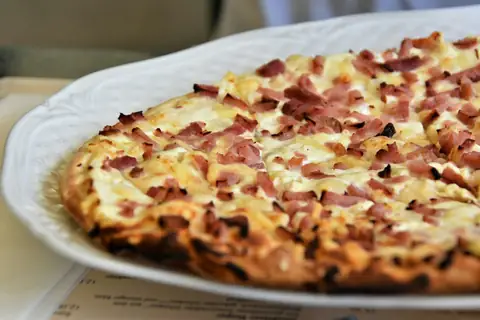
The traditional tarte flambée is deliberately simple: wafer-thin dough topped with a layer of soured cream, crème fraîche or fromage blanc, raw onions in fine rings and diced bacon. Seasoning is salt, pepper and sometimes nutmeg. That is all it needs.
Gratinée
The gratinée version adds grated cheese on top, classically Gruyère or Emmental. It is richer and a little less crisp.
With Munster
For the Munster version, pieces of the pungent Alsatian soft cheese are dotted over the tarte. Not for the faint-hearted, but pure Alsace.
Sweet with apples
For dessert there is tarte flambée with apple slices, sugar and cinnamon. Some restaurants finish this sweet version by pouring over Calvados and setting it alight. Ironically, this is the one tarte flambée that really is flambéed.
Modern takes
Salmon, goat's cheese, pumpkin, figs, mushrooms: today anything goes as long as it tastes good. Purists may frown, but tarte flambée has always been topped with whatever was to hand.
Tarte flambée and pizza: siblings, not twins
Because both are flat, topped and baked in a hot oven, tarte flambée and pizza are often compared. The differences are clear, though:
| Feature | Tarte flambée | Pizza napoletana |
|---|---|---|
| Origin | Rural baking tradition of the Upper Rhine | Urban street food of Naples |
| Shape | Usually rectangular or oval | Round |
| Dough | Originally bread dough, today often yeast-free with oil | Yeast dough of flour, water, salt and yeast |
| Thickness | Wafer-thin right to the edge, hardly any rim | Thin centre, airy rim (cornicione) |
| Base | Soured cream, crème fraîche or fromage blanc | Tomato |
| Classic topping | Onions, bacon | Mozzarella and basil, or garlic and oregano |
| Result | Crisp, almost like a cracker | Soft, pliable, foldable |
If you want the pizza side of the story, read our history of pizza. In short, both belong to the big family of topped flatbreads, but they developed independently.
The dough: bread dough then, often yeast-free now
Because tarte flambée comes from baking day, its dough was originally just the farm's bread dough, leavened with sourdough or yeast and made from whatever flour was available. Many modern recipes skip the yeast and add a little oil so the base bakes thin and crisp. Both approaches are fine. How to make your own dough, with or without yeast, is shown step by step in our tarte flambée dough recipe, and our guide to flour types explains which flour to use.
Tarte flambée has its place at TIAMO too: at some events we run a Flammkuchen edition together with another pizza stand.
What remains of baking day
The farm baking day has all but disappeared, but the tarte flambée has not. It is a reminder that good food does not have to be complicated: a hot oven, a piece of dough, cream, onions, bacon. That its history lives not in old cookbooks but in memories and dialect dictionaries suits it rather well. It has always been food for sharing, and it still is, best eaten straight from the oven, right off the board.
The timeline
1550
Hieronymus Bock's "Flam Kuchen"
The scholar Hieronymus Bock mentions a "Flam Kuchen in nöten" - an emergency bread baked on hot stones or in the ashes.
1591
Bacon flatbread in Basel
The cookbook of Magdalena Platter of Basel includes a flat bacon tart, an early regional relative.
1811
Baked after the bread
Margarethe Spoerlin's Upper Rhine cookbook from Mulhouse describes a yeast-dough bacon tart that goes into the oven after the bread.
into the 20th c.
Farm baking day
On many Alsatian farms bread was baked only every two or three weeks, and tarte flambée was part of baking day.
1960s
Restaurant breakthrough
Tarte flambée becomes a restaurant dish and spreads far beyond the villages.
Frequently asked questions
Where does tarte flambée come from?
From the rural baking tradition of the Upper Rhine. Alsace, especially the Kochersberg northwest of Strasbourg, claims it, but it has long been known in Baden, the Palatinate and Saarland too.
Is tarte flambée actually flambéed?
No. The name refers to the flames in the wood-fired oven, not to setting it alight with alcohol. Only some sweet versions are finished with flaming Calvados.
Was it really baked to test the oven's heat?
That is the widespread traditional explanation, and it is recorded in regional dialect dictionaries. There are, however, hardly any old written recipes or dates to back it up.
What is the difference between tarte flambée and pizza?
Tarte flambée is usually rectangular or oval, extremely thin and topped with soured cream or crème fraîche, onions and bacon. Pizza is round, has an airy rim and classically uses tomato as its base.
Is tarte flambée French or German?
Both, in a way. It belongs to the shared cooking of the Upper Rhine, a region whose borders have moved many times.
Sources
- Brauchtumsgebäcke (Teil 20) - Flammen- und Speckkuchen, panissimo / Swiss bakers' association, Albert Spycher (swissbaker.ch)
- This historic dish is a French staple - just don't call it pizza, National Geographic (nationalgeographic.com)
- The Kochersberg, the beautiful garden, Alsace Destination Tourisme (visit.alsace) (visit.alsace)
- Recette de la tarte flambée ou flammekueche, Le Routard (routard.com)
- Flammkuchen (spelling and meaning), Duden (duden.de)
We check facts against these sources. Spotted a mistake? Write to us and we will fix it.