Contents
- What is Flammkuchen dough?
- The two base recipes in the calculator
- Which flour?
- Step by step: the yeast-free dough
- Rolling it paper-thin
- Toppings: less really is more
- Baking: as hot as possible, as short as necessary
- Common mistakes and how to avoid them
- Flammkuchen vs. pizza
- Flammekueche, tarte flambée, Flammkuchen: the names
- Flammkuchen at TIAMO
- The bottom line
Few dishes look as simple as Flammkuchen: a sheet of dough, a smear of soured cream, onions, bacon. Yet the gap between a floppy flatbread and one that shatters when you bite into it is huge, and almost all of it comes down to the dough and the oven. Here is how Flammkuchen dough started out, how most people make it today, which values you will find in our dough calculator, and what really matters when rolling, topping and baking.
What is Flammkuchen dough?
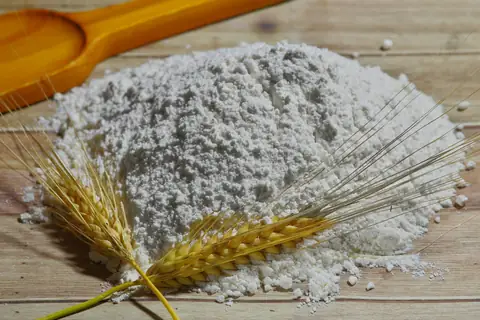
It is a very simple, rather stiff dough made from flour, water, salt and usually a little oil, rolled out as thin as possible. Unlike pizza dough it is not meant to rise much. You are after a crisp, lightly blistered base with browned, sometimes almost blackened edges that stays crisp under a thin layer of cream, onions and bacon.
From bread dough to quick yeast-free dough
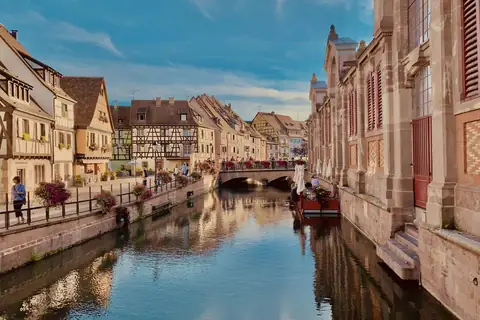
There was originally no such thing as a dedicated Flammkuchen dough. The dish comes from Alsace, traditionally from the Kochersberg area northwest of Strasbourg. On baking day the farm's wood-fired oven was lit for bread. A piece of the bread dough was rolled thin, topped with whatever the farm had, and slid into the first, fierce heat. According to the regional tourism site Visit Alsace, it served as a test of the oven before the loaves went in. The logic is simple: if it blackened too fast, the oven was still too hot for bread.
For the full story, the names and the legends around it, read our piece on the history of Flammkuchen.
These days hardly anyone has spare bread dough lying around, which is why the yeast-free version has become the standard: flour, water, salt and oil, a short knead, a short rest, done. It is ready in about thirty minutes and bakes up almost like a cracker. If you prefer something a little breadier with more flavour, use a small amount of yeast and give the dough time. Both are legitimate; they simply give slightly different results.
The two base recipes in the calculator
Our dough calculator has two Flammkuchen presets. All values are baker's percentages, meaning relative to the flour weight (flour = 100 %). If the water percentage is new to you, our article hydration explained walks through it.
| Version | Water | Salt | Oil | Yeast | Dough ball | Character |
|---|---|---|---|---|---|---|
| Flammkuchen without yeast | 50 % | 2 % | 6 % | none | 180 g | very crisp, cracker-like, quick |
| Flammkuchen with yeast | 55 % | 2 % | 4 % | a little, depending on timing | 180 g | slightly airier, bready, more flavour |
Without yeast: 50 % water, 2 % salt, 6 % oil
At just 50 % hydration this dough is much stiffer than pizza dough, and that is deliberate. A stiff dough rolls out very thin without sticking and loses its moisture quickly in the oven. The oil makes it supple, adds a slight shortness and helps it brown. With no yeast there is no real proof, only a short rest so the gluten relaxes and the dough stops springing back under the rolling pin.
With yeast: 55 % water, 2 % salt, 4 % oil
The yeasted version is a little softer and uses less oil. It develops small bubbles, a touch of volume and a flavour that recalls the old bread-dough original. Time pays off here: with very little yeast and a night in the fridge the dough gets tastier and easier to roll. As a guide from our calculator model, about 0.25 % fresh yeast (relative to flour) suits 24 hours in the fridge plus roughly 2 hours at room temperature. Our article on cold fermentation explains the details.
Which flour?
Flammkuchen dough is easygoing. Because it does not need to rise high or form an open crumb, you do not need strong pizza flour. A regular wheat flour does the job; in Germany people typically use Type 550 or Type 405, with 550 giving the dough a bit more body. Italian Type 00 works too, and a share of spelt or a little rye adds a heartier, rustic note. Our guide to flour types for pizza decodes the numbers.
Step by step: the yeast-free dough
The full recipe for four Flammkuchen is in the recipe box above. The details that make the difference:
- Oven first. The oven needs longer than the dough, so switch it on with the stone, steel or tray inside before you weigh anything.
- Knead. Work flour, water, salt and oil until smooth. The dough is firm and should stay that way. If it is sticky, the flour was weak or there was too much water.
- Divide and rest. Weigh four pieces of about 180 g, round them up and cover. Twenty to thirty minutes is plenty, which is just enough time to slice the onions and bacon.
- Roll. Use a rolling pin rather than your hands. Flammkuchen is rolled, not stretched like pizza.
- Top and bake. Thin topping, then into the hottest heat you have.
You can also make the dough the day before. Well wrapped, it keeps overnight in the fridge without trouble, but let it warm up a little before rolling or it will fight you.
Rolling it paper-thin
This is where Flammkuchen is won or lost. Aim for about 1 to 2 mm. A 180 g ball rolled properly gives you something between half a baking tray and a standard pizza in size, depending on whether you go round, oval or rectangular.
How to get there:
- Little flour, lots of patience. Dust the surface lightly. Excess flour burns in the oven and tastes bitter.
- Centre outwards. Always roll from the middle out, turning the dough as you go so it stays even.
- If it shrinks back, pause. Leave it for a few minutes, then carry on. There is no point wrestling tense gluten.
- Roll on baking paper. No peel? Roll straight onto baking paper and slide paper and all onto the stone or tray. Check the temperature rating on the box; many papers are not made for an oven's top setting and turn dark and brittle.
- Rough edges are fine. Flammkuchen does not need a puffy rim like the cornicione of a pizza. Thin all the way to the edge is exactly right.
Toppings: less really is more
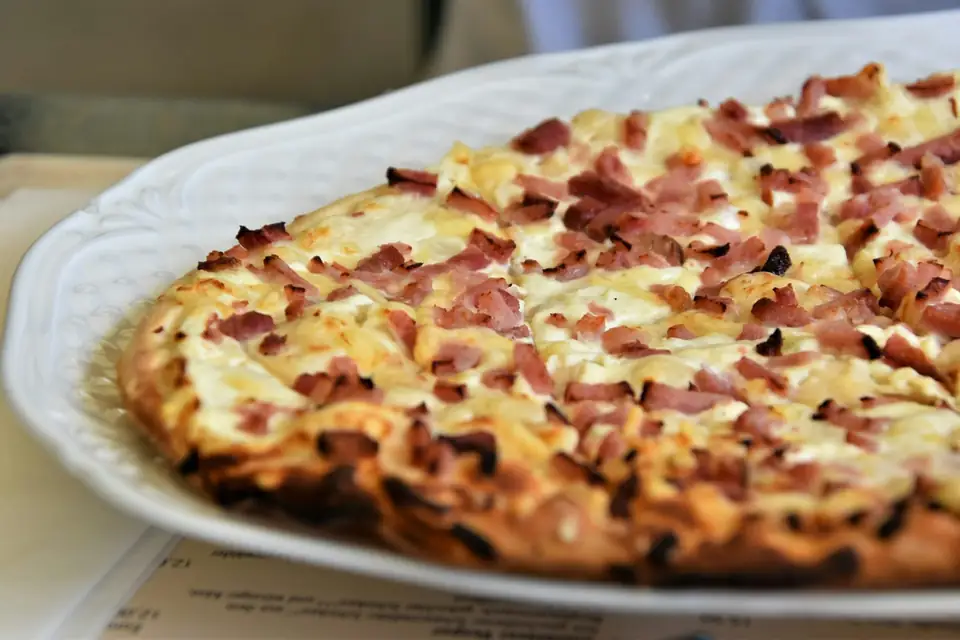
The classic Flammkuchen has three things on it: a soured-cream spread, onions and bacon. Cheese is not part of the original; it is a later variation, often sold as a "gratinée" version.
The cream: crème fraîche, fromage blanc or Schmand
According to Visit Alsace, the original spread was fromage blanc mixed with thick cream and seasoned with salt, pepper and a splash of oil. In Germany most people use crème fraîche or Schmand, a thick soured cream that sits between sour cream and crème fraîche.
| Base | Typical fat content | Result |
|---|---|---|
| Crème fraîche | usually around 30 % or more | very creamy, holds up in the heat, mildly tangy |
| Schmand | usually around 20 to 24 % | a little lighter and tangier, also heat-stable |
| Fromage blanc / quark | depends on the product | fresh and light, a bit dry on its own |
| Crème fraîche + fromage blanc | in between | creamy and fresh, close to the Alsatian original |
Season with salt, pepper and, if you like, a pinch of nutmeg. Quantity is the key: a thin layer through which the dough almost shows is better than a thick blanket. Too much cream means too much moisture, and the middle goes soft.
Onions
Traditionally the onions go on raw, sliced into the thinnest rings or strips you can manage. In the short, fierce heat they soften, sweeten and catch a little colour at the tips. If you prefer them milder you can sweat them briefly first, but drain them well or they will bring extra moisture.
Bacon
Smoked bacon cut into thin strips or small dice, the Alsatian "lardons", is the classic. Put on raw, it renders in the oven and seasons everything around it. Chunky cubes will not crisp in such a short bake, so cut finely. For a vegetarian version simply leave it out or replace it with something with bite and flavour, such as leek, mushrooms or a little mountain cheese.
Baking: as hot as possible, as short as necessary
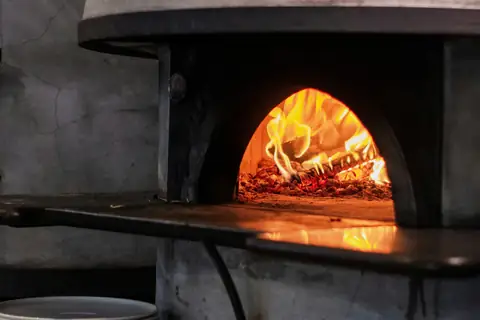
Flammkuchen was born in the wood-fired oven, baked in its first and strongest heat, and that is still what it wants: plenty of heat from below for a crisp base and plenty from above so the topping cooks before the dough dries out. In a wood-fired or proper pizza oven that takes only a few minutes. A home oven needs a few tricks.
Home oven tips
- Maximum setting. Turn the dial all the way up, which is 250 to 300 °C on many ovens. A fan setting can speed up preheating; for the bake itself, test whether your oven does better with top and bottom heat or with the fan.
- Stone or steel. Both store heat and pass it quickly into the base. King Arthur Baking recommends preheating either one for at least an hour. Steel conducts heat better and browns more strongly. Stones, often made of cordierite, can crack over time, whereas steel is close to indestructible.
- No stone? Preheat a tray. An upside-down baking tray heated with the oven is the best stand-in. Slide the Flammkuchen on using baking paper.
- Let it recover. After each Flammkuchen the stone or steel needs a few minutes to soak up heat again. King Arthur suggests at least five minutes; otherwise each one comes out a little paler.
- Bake by eye, not by clock. It is ready when the edges are deep brown to patchy dark, the bacon sizzles and the base is rigid when you lift it. In a home oven that usually means 6 to 12 minutes, depending on the oven.
If you bake Flammkuchen often or for a crowd, sooner or later you will want a dedicated oven. Our pizza oven buying guide covers what to look for.
Common mistakes and how to avoid them
| Problem | Likely cause | Fix |
|---|---|---|
| Soggy middle | dough too thick, too much cream, oven too cool | roll thinner, top lighter, preheat longer |
| Dough shrinks when rolling | gluten still tight | rest 10 minutes, then continue |
| Sticky dough | too much water or very weak flour | knead in a little flour, use less water next time |
| Base hard like cardboard but pale | baked too long at too low a temperature | hotter and shorter, use a stone or steel |
| Bitter, dusty base | too much bench flour burnt | dust sparingly, brush off excess |
| Chewy bacon | pieces too thick | cut into thin strips |
| Yeasted dough turns out like pizza | too much yeast or proofed after rolling | reduce yeast, bake right after rolling |
Flammkuchen vs. pizza
Flammkuchen is often called "Alsatian pizza". They are relatives, both flatbreads from a hot oven, but they work very differently.
| Flammkuchen | Pizza (e.g. Neapolitan) | |
|---|---|---|
| Dough | very stiff, 50 to 55 % water, with oil, no or little yeast | softer, around 60 % water, traditionally no oil, yeast or sourdough |
| Fermentation | none, or short to overnight | many hours to days |
| Shaping | rolled with a pin | stretched by hand |
| Thickness | 1 to 2 mm right to the edge | thin centre, airy rim |
| Base | soured cream | tomato |
| Cheese | traditionally none | mozzarella or fior di latte |
| Classic topping | onions, bacon | varies, used sparingly |
| Result | crisp and shattering | soft, elastic, leopard-spotted rim |
For a deep dive into the other side of the family, read our big guide to the perfect pizza dough.
Flammekueche, tarte flambée, Flammkuchen: the names
In Alsace the dish is called Flammekueche; in French it is tarte flambée. "Flambée" sounds like flambéed, but it really means the flames of the oven. The German Duden dictionary marks "Flammkuchen" as a regional word and also lists the rarer form "Flammenkuchen". Across the Rhine in Germany it is most at home in Baden, the Palatinate (Pfalz) and Saarland, and is a fixture at village fairs and Christmas markets. Similar bread-dough flatbreads exist in other regions under their own names, such as the Dinnete in Upper Swabia, which locals also call the "Swabian pizza". The whole story is in our article on the history of Flammkuchen.
Flammkuchen at TIAMO
Pizza is our first love, but at some events we run a Flammkuchen edition together with another pizza stand. In principle Flammkuchen suits a pizza oven well: both want plenty of heat and a short bake.
The bottom line
Perfect Flammkuchen dough is no secret. Firm dough, little water, a bit of oil, rolled paper-thin, topped with restraint and baked in the fiercest heat you have. Without yeast it is ready in half an hour and wonderfully crisp; with yeast and a night in the fridge it becomes breadier and more flavourful. Try both versions in the dough calculator and see which one you prefer.
The timeline
The recipe
Yeast-free Flammkuchen dough for 4
- Makes:
- 4 Flammkuchen (approx. 180 g dough each)
- Total time:
- 1 h 15 min
Ingredients
- 450 g wheat flour (plain or bread flour)
- 225 g water (50 %)
- 9 g salt (2 %)
- 27 g neutral oil or olive oil (6 %)
- 200 g crème fraîche
- 200 g fromage blanc or Schmand
- Salt, pepper, a little nutmeg
- 2-3 onions (approx. 250 g), very thinly sliced
- 200 g smoked bacon cut into thin strips (lardons)
Method
- 1Preheat the ovenPut a baking stone, steel or tray on a middle to lower shelf and heat the oven to its maximum (usually 250 to 300 °C) for at least 45 to 60 minutes.
- 2Mix the doughKnead flour, water, salt and oil for 5 to 8 minutes into a smooth, fairly firm dough that does not stick.
- 3RestDivide into 4 pieces of about 180 g, shape into balls, cover and rest for 20 to 30 minutes at room temperature.
- 4Prepare the toppingStir crème fraîche with fromage blanc or Schmand, season with salt, pepper and a little nutmeg. Slice the onions paper-thin and cut the bacon into thin strips.
- 5Roll paper-thinRoll each ball out on a lightly floured surface or on baking paper to 1 to 2 mm, round, oval or rectangular.
- 6Top lightlySpread a thin layer of cream almost to the edge, scatter onions and bacon loosely on top. Do not overload.
- 7Bake hot and fastBake on the stone, steel or tray until the edges are deep brown or slightly charred and the base is crisp, usually 6 to 12 minutes in a home oven. Serve straight away.
Frequently asked questions
Does Flammkuchen dough contain yeast?
It can go either way. The original was simply bread dough, so it was leavened. Today most Flammkuchen dough is made without yeast because it is quick and bakes up extra crisp.
How thin should Flammkuchen dough be?
As thin as you can manage, roughly 1 to 2 mm. If you can almost see the counter through it, you are there.
What oven temperature do I need?
The highest your oven goes, usually 250 to 300 °C. Ideally on a baking stone or steel preheated for about an hour, otherwise on a preheated tray.
Crème fraîche, fromage blanc or Schmand?
All three work. Crème fraîche is richest, Schmand is a little lighter and tangier, and fromage blanc adds freshness. A mix of crème fraîche and fromage blanc is close to the Alsatian original.
Why is my Flammkuchen soggy in the middle?
Usually the dough is too thick, there is too much topping or the oven is not hot enough. Roll thinner, top more sparingly and preheat longer.
Sources
- Share a tarte flambée with good company, Visit Alsace (Alsace Destination Tourisme) (visit.alsace)
- Cuisiner une délicieuse tarte flambée alsacienne à la maison, Explore France / France.fr (france.fr)
- Brauchtumsgebäcke (Teil 20) - Flammen- und Speckkuchen, panissimo / Swiss bakers' association, Albert Spycher (swissbaker.ch)
- Flammkuchen (spelling and meaning), Duden (duden.de)
- Bäckerlehrlinge im Backdorf Heiligkreuztal zu Besuch, Schwäbische Zeitung (schwaebische.de)
- Pizza steel vs. stone: What's best for making pizza?, King Arthur Baking (kingarthurbaking.com)
We check facts against these sources. Spotted a mistake? Write to us and we will fix it.