Contents
Once you have eaten a pizza from a properly hot oven, with a puffy rim and little dark spots on the crust, you start wanting to bake one yourself. And then comes the big question: wood, gas or electric? At TIAMO we bake at markets and festivals around Frankfurt from our mobile stand, so this question is close to our hearts. There is no one-size-fits-all answer, but we can show you what really matters. You will not find test winners or shopping links here, just the background you need to decide for yourself.
How a pizza oven bakes: three ways heat gets in
Before we compare fuels, it helps to understand what happens inside the oven. A pizza picks up heat in three ways.
Conduction from the floor
The dough sits directly on the hot floor, and heat moves into it by contact. This is what decides whether the base turns crisp, browned and cooked through. How aggressively the floor bakes depends not only on its temperature but also on its material. The physicists Varlamov, Glatz and Grasso worked this out in 2018: on brick at 330 °C, the underside of the pizza reaches roughly 210 °C, while on steel at the same temperature it reaches about 300 °C. Steel hands over heat far faster than ceramic or firebrick.
Radiation from above
The dome, the walls and the flame radiate heat, which cooks the toppings and makes the rim rise. The same paper points out that radiated power grows with the fourth power of absolute temperature, so a slightly hotter oven sends noticeably more energy onto the pizza. That is why a hot floor alone is not enough: without a hot dome you get a dark base and pale, undercooked toppings.
Hot air
The third part is hot air moving around the pizza. In wood and gas ovens with an open flame it plays a role, but a smaller one than floor and radiation. The paper deliberately leaves it out of its model as a minor effect.
What temperatures do you need?
For Neapolitan pizza, the AVPN rules are clear: around 380 to 430 °C on the floor, about 485 °C in the dome and a bake time of 60 to 90 seconds. (The 2010 EU specification for the TSG "Pizza Napoletana" splits the numbers the other way round, with about 485 °C on the floor and 430 °C in the dome. In practice the message is the same: very hot, with floor and dome in balance.)
Other styles need less. New York style and home-oven pizza bake longer at lower temperatures, and Roman teglia is baked in a tray. What this means for your dough is covered in our guide to pizza dough.
| Oven | Typical floor temperature | Bake time (guide) |
|---|---|---|
| Neapolitan (AVPN) | approx. 380 to 430 °C, dome approx. 485 °C | 60 to 90 seconds |
| Compact wood or gas oven | up to approx. 500 °C per maker, depending on model | approx. 1 to 2 minutes |
| Professional electric deck oven | often up to approx. 450 °C per data sheet | longer than wood-fired, depending on settings |
| Home oven with stone or steel | approx. 250 to 300 °C | approx. 5 to 10 minutes |
The main oven types
Wood-fired, built or cast refractory
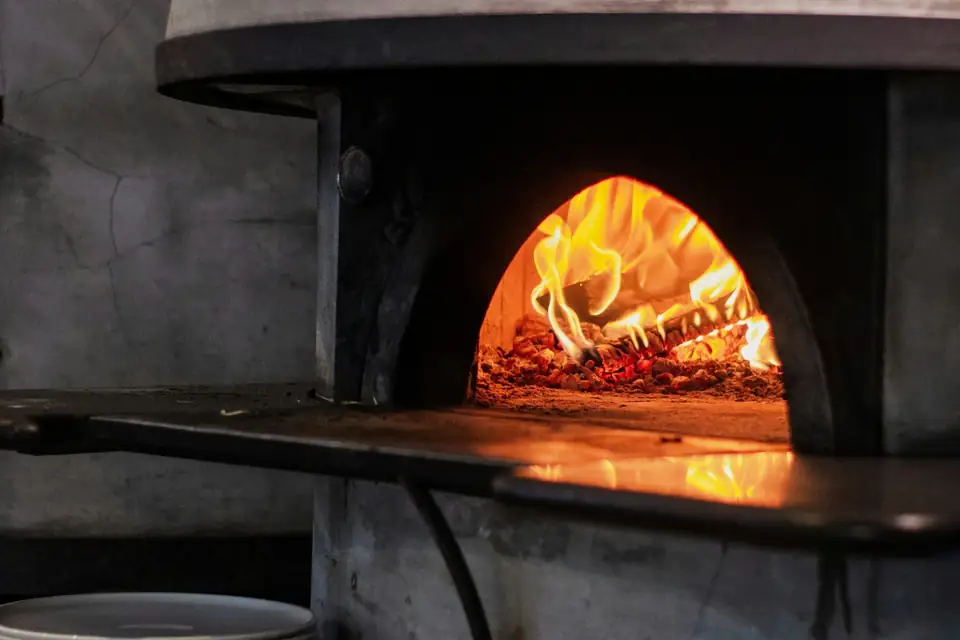
The classic. A built oven has a dome of refractory bricks or refractory concrete and a floor of firebrick or clay. The AVPN rules describe the traditional Neapolitan oven with a double dome and a floor made of four pieces laid on a bed of sand and salt, which acts as insulation and heat store.
Its great strength is thermal mass: the heavy structure holds heat for a long time and releases it evenly. In return it needs time to heat up, more like hours than minutes depending on the mass. You have to manage the fire, add wood and push the embers aside. It is a craft, and a very rewarding one. Flavour and looks are hard to beat, and so is the effort.
Compact gas ovens
Portable gas ovens have found their way into many gardens. They usually have a cordierite stone, a burner at the back or side and a low opening. Ooni, for example, states that its Koda 16 reaches up to 500 °C in about 20 minutes; it has a 15 mm cordierite stone and weighs just over 18 kg unboxed. Other makers such as Gozney sell comparable ovens.
Gas is fast, clean and easy to control. The downside is the small thermal mass: the stone loses some heat with every pizza and needs a moment to recover. And since the heat comes mostly from one side, you have to turn the pizza.
Multi-fuel and hybrid
Some ovens run on wood or charcoal and can be fitted with a gas burner. Ooni says the Karu 2 Pro burns wood or lump charcoal out of the box and runs on gas with a separately sold burner. That lets you play with fire on relaxed evenings and switch to gas on busy days. The trade-off is more weight (the maker lists it at just over 28 kg unboxed) and more accessories.
Electric countertop ovens
Countertop electric pizza ovens usually have heating elements above and below and a low baking chamber. The Italian maker Effeuno, for instance, rates its P134H 509 PRO at up to 509 °C. The maker advertises its ovens as suitable for 3 kW connections, which means an ordinary household socket. The exact power rating is in each model's data sheet.
The upside: no fire, no gas, even and repeatable heat, even on a balcony or in the kitchen. The limit: power is capped by the socket, and usually only one pizza fits at a time.
Professional electric deck ovens
Pizzerias and snack bars often use electric deck ovens with firebrick floors. A typical data sheet for a four-pizza model (34 cm each) lists up to 450 °C, 6.6 kW on a 400 V three-phase supply and about 85 kg. These ovens bake several pizzas at once and hold temperature very steadily, but they need a heavy-duty power connection and plenty of space.
Which floor material?
The floor is the heart of every pizza oven. You will keep meeting three materials:
- Cordierite: a refractory ceramic with low thermal expansion. It handles quick and large temperature swings well, which is why it is widely used for pizza stones, especially in compact gas and multi-fuel ovens.
- Firebrick: a refractory material made from fired clay, the classic lining for stoves and built ovens. It stores a lot of heat and conducts it relatively slowly, giving an even base that is not too harsh.
- Clay floor tiles ("biscotto"): Neapolitan tradition uses clay tiles from the Sorrento area, often called "biscotto di Sorrento". They are regarded as more porous and gentler on the base. Some electric countertop ovens are sold with such tiles too.
Steel is the fourth candidate, mainly as a baking steel in a home oven. It conducts heat extremely fast, which helps at 250 °C but would burn the base at 450 °C.
Wood vs gas vs electric
| Criterion | Wood | Gas | Electric |
|---|---|---|---|
| Achievable temperature | very high, depends on the fire | compact models up to approx. 500 °C per maker | countertop models partly over 500 °C, deck ovens often up to approx. 450 °C |
| Heat-up time | long, built ovens more like hours | short, compact models around 20 minutes per maker | varies, check the maker's figures |
| Control | takes practice | good, via a dial | very good, via thermostat |
| Thermal mass | large (built) to medium | rather small | medium to large (deck oven) |
| Flavour | wood fire, slightly smoky | neutral | neutral |
| Supply | dry wood, storage space | propane cylinder, regulator, hose | household socket or three-phase |
| Weight | compact multi-fuel around 30 kg, built ovens easily several hundred kg | compact models around 20 kg | countertop portable, deck ovens often 80 kg or more |
| On-site hassle | sparks, ash, smoke | gas cylinders, safety rules | needs the right power connection |
| Typical use | gardens with space, enthusiasts, pros | garden, camping, small events | flat, balcony, snack bar, market with power |
Home use or market stand?
What you really need at home
For four to eight pizzas in an evening, almost any compact oven will do. More important than the maximum temperature are three questions:
- Where will it stand? Gas and wood belong outdoors, away from anything flammable. Electric can go indoors.
- How often will you use it? If you bake every week, short heat-up times are a joy. If you host four parties a year, a wood fire is easy to plan in.
- How big will your pizzas be? A 12-inch oven (about 30 cm) feels tighter than you think. A 16-inch opening (about 40 cm) gives you more room when launching with the peel.
What counts at a market stand
At a market the priorities shift towards hours of continuous output, transport and permits.
Power supply. A standard 16 A socket on 230 V delivers around 3.7 kW in theory, and you should not run it flat out for hours. A three-phase CEE connection at 16 A (400 V) delivers about 11 kW, at 32 A about 22 kW. Whether such a connection is available on site is up to the organiser, so always ask before you sign up, and remember that fridges, lights and the till need power too.
Gas. Gas ovens usually run on propane from cylinders. You need a regulator that matches the appliance, suitable hoses and a hose-break safety valve, and the installation has to be inspected regularly. The details are in our article on pizza oven safety at events.
Wood. Wood-fired ovens at markets are a treat for guests, but they are not allowed everywhere. Sparks, smoke and ash are things organisers and fire services look at closely.
Weight and transport. A compact oven fits in a car boot. A deck oven of 80 kg or more needs two people and a van, and a built oven usually needs its own trailer. With trailers, always check the permitted gross weight and your driving licence category.
Throughput. You can estimate pizzas per hour roughly. At 60 to 90 seconds per bake, a one-pizza oven could in theory turn out 40 to 60 pizzas an hour. In practice that does not happen: stretching, topping, launching and taking payment all take time, and a small stone needs to recover between pizzas. An oven that holds several pizzas at once and a well-drilled team make the real difference. How to work out your stand's output and organise the flow is covered in pizza at the market.
Our own oven
At TIAMO we bake on an electric pizza oven with a rotating stone that reaches 500 °C. If you are thinking about a stand of your own, test every candidate against the same questions: does it stay steadily hot for many hours, can your vehicle carry it, does its energy supply match the sites you want to trade at, and does it meet the organisers' requirements?
What does it cost?
We deliberately do not give price ranges here. Prices vary widely with size, fuel, material and manufacturer, and they change all the time. Compare current offers (as of October 2026) and check whether the stone, cover or gas burner are included. As a general rule, a compact garden or countertop oven is a very different investment from a professional deck oven or a large mobile oven for commercial use, and built ovens depend heavily on the construction. Budget for extras too: a peel, a turning peel, an infrared thermometer, a cover, a regulator and hose for gas, and a supply of dry hardwood for wood.
Dough and oven belong together
The best oven is of little use if the dough does not suit the heat. For very hot ovens around 450 °C, a classic Neapolitan dough without oil or sugar works well. If your oven bakes cooler and longer, a little oil keeps the dough from drying out. Our dough calculator has a dedicated preset for mobile high-heat ovens with 62 % hydration, 2.5 % salt and 1 % oil.
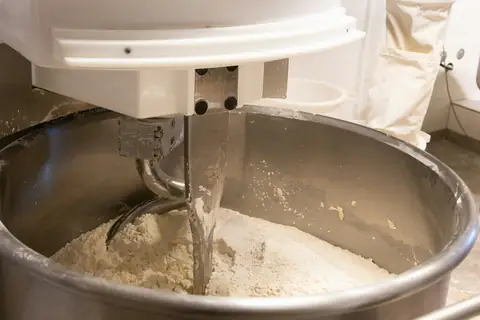
If you make larger batches, for a market or a big party, the mixing is worth a thought as well. What a mixer needs to handle is explained in a dough mixer for pizza. And since many pizza ovens also bake tarte flambée, the matching dough is in our tarte flambée dough guide.
Checklist before you buy
| Question | What to look for |
|---|---|
| Which style do you want to bake? | Neapolitan needs well over 400 °C, other styles less |
| Where will the oven stand? | gas and wood outdoors only, electric indoors too |
| What energy is available? | a household socket is fine for countertop ovens, deck ovens usually need three-phase |
| How big is the opening? | rather a bit larger than your planned pizza |
| What is the floor made of? | cordierite, firebrick or clay, check the thickness |
| How heavy is it? | transport, ground surface, number of helpers |
| How many pizzas per hour? | room for several pizzas, recovery time of the floor |
| What do organisers and authorities say? | for markets, check in advance whether wood, gas or electric is allowed |
| Are spare parts available? | stones, burners, heating elements |
Bottom line
Wood is the experience, gas the fast everyday hero, electric the predictable solution. For the garden, a compact gas or multi-fuel oven usually wins; for a flat, an electric countertop oven; and for professional use, whichever oven matches your power supply, your permits and your throughput. If you are unsure, come by our stand, watch us bake and just ask. Pizza con amore starts with the right heat.
The timeline
Frequently asked questions
Which pizza oven is best for home use?
For most gardens, a compact gas or multi-fuel oven is the easiest start because it heats up quickly and is light. If you love live fire and have the space, wood will make you happier, and without a garden an electric countertop oven is the obvious choice.
How hot does a pizza oven need to be for Neapolitan pizza?
The AVPN rules give roughly 380 to 430 °C on the floor and about 485 °C in the dome, with a bake time of 60 to 90 seconds. Many compact wood and gas ovens are rated by their makers at around 500 °C.
Can I run an electric pizza oven from a normal socket?
A standard 16 A household socket on 230 V delivers about 3.7 kW at most. That covers many electric countertop ovens, but not professional deck ovens, which usually need a three-phase supply.
Cordierite or firebrick, which is better?
Both are heat-resistant ceramics. Cordierite copes particularly well with rapid temperature changes, which is why it is common in pizza stones, while firebrick stores a lot of heat and is the classic material for built ovens.
How many pizzas per hour can a small oven handle?
With bake times of 60 to 90 seconds, the oven is rarely the bottleneck; stretching and topping are. A small oven only holds one pizza at a time, and the stone needs a moment to recover after each bake.
Sources
- Disciplinare Internazionale Verace Pizza Napoletana (English version 2024), Associazione Verace Pizza Napoletana (AVPN) (pizzanapoletana.org)
- The Physics of baking good Pizza, A. Varlamov, A. Glatz, S. Grasso (arXiv) (arxiv.org)
- Ooni Koda 16 Gas Powered Pizza Oven, Ooni (uk.ooni.com)
- Ooni Karu 2 Pro Multi-Fuel Pizza Oven, Ooni (ca.ooni.com)
- P134H 509 PRO - Electric pizza oven up to 509 °C, Effeuno (effeuno.biz)
- Electric deck pizza oven, fireclay deck, 4 x 34 cm, up to 450 °C (technical data), GGM Gastro (ggmgastro.com)
- Commission Regulation (EU) No 97/2010, Annex II: Pizza Napoletana TSG specification, legislation.gov.uk (EUR 2010/97) (legislation.gov.uk)
We check facts against these sources. Spotted a mistake? Write to us and we will fix it.
Independent: no advertising, no affiliate links, no paid recommendations.