Contents
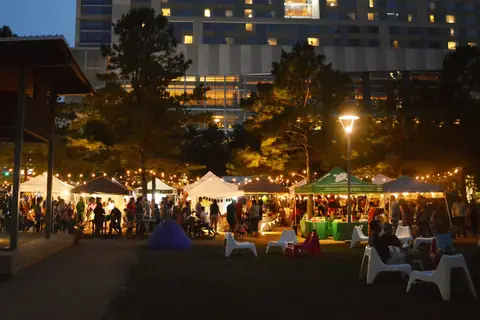
Baking pizza in a restaurant is one thing. Baking pizza at a market, between the vegetable stall and the coffee van, with wind from the side and a queue at the counter, is something else. What counts here is not just the dough but the whole flow, from the evening before to the last pizza box. And at the end of the day, the numbers have to work.
This article shows how a pizza stand can be organised, how to estimate output per hour and how to cost a pizza properly. Every figure in the worked examples is an example value for you to recalculate, not a statement about our own costs.
The flow: from dough to till
Planning the dough
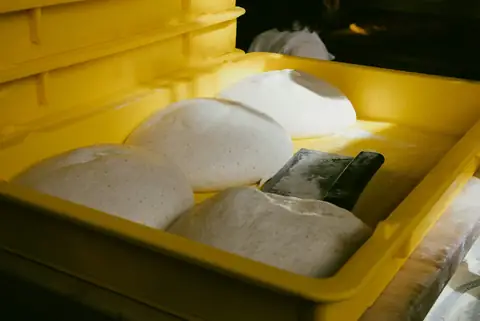
Everything starts with an estimate: how many pizzas will you sell today? That gives you the number of dough balls, plus a buffer. If you work with a cold ferment, you make the dough one to three days ahead, which gives you a steady rhythm. The upside: the dough is more flavourful and more predictable. The downside: you commit to quantities early.
Your own records are the best guide. After every market day, note how many dough balls you brought and how many came back. After a few weeks, patterns by weekday, season and weather start to show.
Transport and cold chain
Dough balls usually travel in closed, stackable dough boxes. Keep them cool on the way so fermentation does not run away from you. At the stand, take them out of the cooler early enough to stretch easily; how early depends on the dough and the weather.
Mozzarella, cured meats and other chilled ingredients are stored as the manufacturer specifies, in a cool box or fridge, not in the sun next to the oven. Only put out at the topping station what you will use in a short time.
Workstations
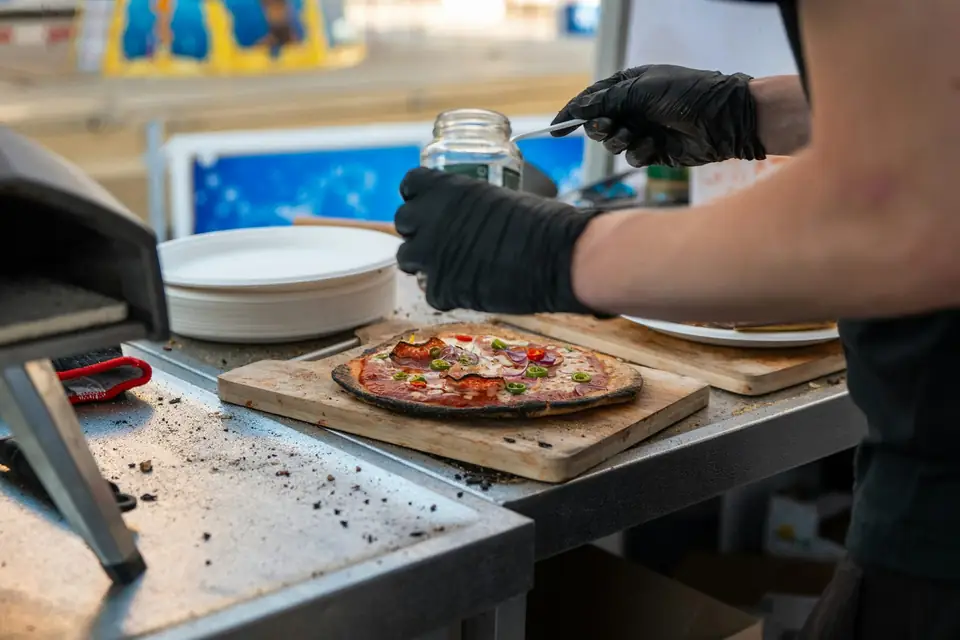
A good stand is like a small production line. Every station has a fixed place and the pizza moves in one direction:
- Stretch: dough ball out of the box, shaped into a base with a little flour or semolina.
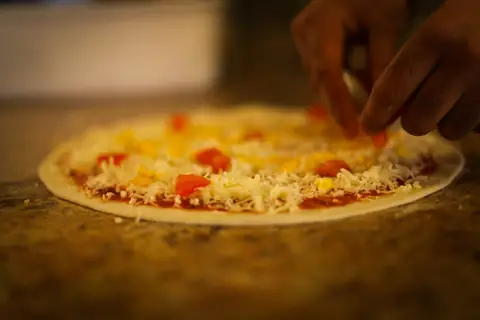
- Top: tomato, cheese, toppings, all within reach. How much goes where is covered in our rules for good toppings.
- Bake: launch, turn, retrieve.
- Cut and pack: pizza wheel, box or paper.
- Till and hand-out: payment, drinks, deposits.
With two people on the stand, one often stretches and tops while the other runs the oven, cuts and takes payment. The key is that paths do not cross and nobody has to handle the till with doughy hands.
How many pizzas per hour?
A stand's output depends on three things: how many pizzas fit in the oven at once, how long one round takes, and how fast the other stations are.
Theoretical oven output per hour = oven slots × 60 / cycle time in minutes
Cycle time is not just bake time. It is bake time plus launching, turning, retrieving and the short pause until the oven floor has recovered its heat.
| Input | Example value |
|---|---|
| Oven slots | 2 pizzas at a time |
| Bake time | 90 seconds |
| Handling and floor recovery | 30 seconds |
| Cycle time | 2 minutes |
| Theoretical oven output | 2 × 60 / 2 = 60 pizzas per hour |
That is a ceiling. In practice another station almost always slows things down: if one person needs two minutes to stretch and top a pizza, they manage 30 an hour, however fast the oven is. So calculate each station separately and take the lowest value, then leave room for breaks, questions and payment.
How hot and how fast an oven works depends on the model. What to look for is covered in our pizza oven buying guide.
Keep the menu short
Fewer options mean a faster flow. Every extra pizza means more ingredients in the cooler, more containers at the topping station, more decisions for the customer and more waste at the end of the day. Many successful stands stick to two to four pizzas that share ingredients.
That is how we keep it at TIAMO: Margherita and Salami, as a whole pizza or by the slice (one sixth). At events we share with another pizza stand, we offer a Flammkuchen edition instead.
Whole pizza or slice?
| Whole pizza | Slice | |
|---|---|---|
| Customers | groups, families, the very hungry | passers-by, the curious, kids |
| Planning | simple, baked to order | pizzas are baked ahead, demand must be estimated |
| Waiting time | a few minutes | short when slices are ready |
| Risk | low | slices left out too long lose quality |
Costing: what a pizza really costs
Ingredient cost per pizza
Ingredient cost (food cost) is the sum of all ingredients and packaging for one pizza. The easiest way is to work in grams with your real purchase prices per kilo. The following example uses made-up example prices:
| Ingredient | Quantity | Example price | Cost |
|---|---|---|---|
| Flour (250 g dough ball) | 151 g | 1.20 €/kg | 0.18 € |
| Salt, yeast, oil in the dough | a few grams | flat rate | 0.03 € |
| Tomatoes | 80 g | 3.00 €/kg | 0.24 € |
| Mozzarella | 90 g | 9.00 €/kg | 0.81 € |
| Olive oil for drizzling | 5 g | 10.00 €/kg | 0.05 € |
| Basil | a few leaves | flat rate | 0.05 € |
| Box and napkin | 1 | flat rate | 0.30 € |
| Ingredient cost | 1.66 € |
The flour amount comes from our calculator's reference values for a market dough (62 % hydration, 2.5 % salt, 1 % oil). Run your own numbers in the dough calculator.
From gross to net price
At the stand you display final prices including VAT. For costing, though, you need the net price, because the VAT belongs to the tax office. With an example selling price of 10.00 € and 7 % VAT, the net price is 10.00 € / 1.07 = 9.35 €. The ingredient cost of 1.66 € is about 18 % of that.
Worked example for one market day
Now add the costs that come with each day. Again, all example values.
| Item | Calculation | Amount |
|---|---|---|
| Net revenue | 80 pizzas × 9.35 € | 748.00 € |
| Ingredient cost | 80 × 1.66 € | - 132.80 € |
| Waste (leftover dough balls, opened ingredients) | flat 5 % of ingredient cost | - 6.64 € |
| Pitch fee | example | - 80.00 € |
| Staff | 2 people × 7 hours × 18 € | - 252.00 € |
| Oven fuel, travel | example | - 60.00 € |
| Result before fixed costs | 216.56 € |
Fixed costs still have to come out of that: oven and vehicle, insurance, card terminal, accountant, repair reserves and the days when it rains.
Break-even: how many pizzas?
Contribution per pizza = net price - ingredient cost - waste per pizza
In the example: 9.35 € - 1.66 € - 0.08 € = 7.61 €. Daily costs for pitch, staff and fuel add up to 392 €. 392 € / 7.61 € is about 52 pizzas you need to sell before a single euro goes towards fixed costs. That number is the key figure for deciding whether a market is worth it.
Pitch fees, staff, waste and weather
Pitch fee: depending on the market it can be a flat daily fee, a fee per metre of frontage or a share of revenue, sometimes with power and water charged on top. Ask exactly what is included.
Staff: count real working hours including setup, teardown, travel and cleaning, not just opening hours.
Waste: leftover dough balls, opened cheese, burnt or dropped pizzas. Recording leftovers helps you plan dough more precisely over time.
Weather: rain and heat change footfall dramatically. A gazebo with side walls protects oven and team but does not replace customers. Plan dough on the lean side for uncertain days and keep a plan B, such as a second market the next day, if your dough allows it.
German rules and paperwork
Business registration and travelling trade card
A pizza stand is a business and has to be registered with the local trade office before you start. Anyone offering goods away from fixed business premises generally needs a travelling trade card (Reisegewerbekarte) under Section 55 of the Trade Regulation Act. Section 55a lists exemptions, for example for selling at trade fairs, exhibitions and public festivals. Whether your situation qualifies is best clarified in advance with the trade office and the organiser. Stands on public streets and squares may also need a special use permit.
Food hygiene
Anyone handling food commercially needs a certificate from the public health office confirming the instruction under Section 43 of the Infection Protection Act before starting. It must not be older than three months when you begin; after that the employer has to repeat the instruction every two years and document it. Your business also has to be registered with the local food safety authority. At the stand, a hand-washing facility, clean work surfaces and reliable cooling are the basics. If you work with gas or open flame, also read our article on pizza oven safety at events.
Price display
Under the Price Indication Ordinance, consumers must see the total price, meaning the final price including VAT. A deposit is shown next to the total price, not included in it (Section 7). So your board reads, for example, "Lemonade 2.50 € plus 0.25 € deposit".
VAT: 7 % on food, 19 % on drinks
Since 1 January 2026, restaurant and catering services in Germany are permanently taxed at the reduced rate of 7 % (Section 12 (2) No. 15 of the VAT Act), explicitly excluding drinks. For food it therefore no longer matters whether it is eaten on site or taken away. Drinks stay at the standard rate of 19 %. Special rules exist for certain milk drinks, which rarely matter for a pizza stand.
| Item | VAT rate since 1 Jan 2026 |
|---|---|
| Pizza, Flammkuchen, pizza slice (on site or to go) | 7 % |
| Drinks (can, bottle, cup) | 19 % |
Important for the till: food and drinks have to be recorded separately. If you sell a pizza-and-drink deal, the price has to be split between the two rates. How to do this correctly, and how to treat the deposit for tax purposes, is a question for your tax adviser.
Payment
Many customers now pay by card or phone, others only in cash. A mobile card terminal with a stable connection and a well-stocked float are both essential. Card payments come with fees that belong in your costing. If you use an electronic till, Germany has specific requirements for tamper protection and receipts; your tax adviser can help here too.
Bottom line
A pizza stand runs on a simple principle: a short menu, clear stations, an oven that keeps up and a costing you fill honestly with your own numbers. Work out the minimum number of pizzas before every new market, plan dough with a buffer and write down what was left after each day. Over time, gut feeling turns into experience.
The timeline
Frequently asked questions
How many pizzas can a stand make per hour?
It depends on oven slots, bake time and handling. The rule of thumb is oven slots times 60 divided by the cycle time in minutes. The slowest station, often stretching and topping, sets the real limit.
Which VAT rate applies to pizza at a stand in Germany?
Since 1 January 2026, food in restaurants and catering is permanently taxed at the reduced rate of 7 %, whether eaten on site or taken away. Drinks remain at 19 %. Check individual cases with a tax adviser.
Do I include the deposit in the price?
No. Under the German Price Indication Ordinance a deposit has to be stated next to the total price and must not be included in it, for example "Lemonade 2.50 € plus 0.25 € deposit".
Do I need a travelling trade card for a market?
It depends. Many mobile stands in Germany need a Reisegewerbekarte, but there are exemptions, for example for public festivals. Ask the local trade office and the organiser in advance.
Whole pizzas or slices?
Both have their advantages. Whole pizzas are easier to plan, slices attract passers-by and cut waiting times. Many stands offer both.
Sources
- German VAT Act, Section 12 Tax rates (Umsatzsteuergesetz § 12), German Federal Ministry of Justice, gesetze-im-internet.de (gesetze-im-internet.de)
- Reduced VAT rate on food from 1 January 2026, IHK Darmstadt Rhein Main Neckar (ihk.de)
- Price Indication Ordinance, Section 2 Definitions (PAngV § 2), German Federal Ministry of Justice, gesetze-im-internet.de (gesetze-im-internet.de)
- Price Indication Ordinance, Section 7 Refundable deposit (PAngV § 7), German Federal Ministry of Justice, gesetze-im-internet.de (gesetze-im-internet.de)
- Trade Regulation Act, Section 55 Travelling trade card (GewO § 55), German Federal Ministry of Justice, gesetze-im-internet.de (gesetze-im-internet.de)
- Trade Regulation Act, Section 55a Exemptions (GewO § 55a), German Federal Ministry of Justice, gesetze-im-internet.de (gesetze-im-internet.de)
- Infection Protection Act, Section 43 Instruction and certificate (IfSG § 43), German Federal Ministry of Justice, gesetze-im-internet.de (gesetze-im-internet.de)
- Starting a food truck or snack van (Gründung eines Foodtrucks/Imbisswagens), IHK Köln (ihk.de)
We check facts against these sources. Spotted a mistake? Write to us and we will fix it.