Contents
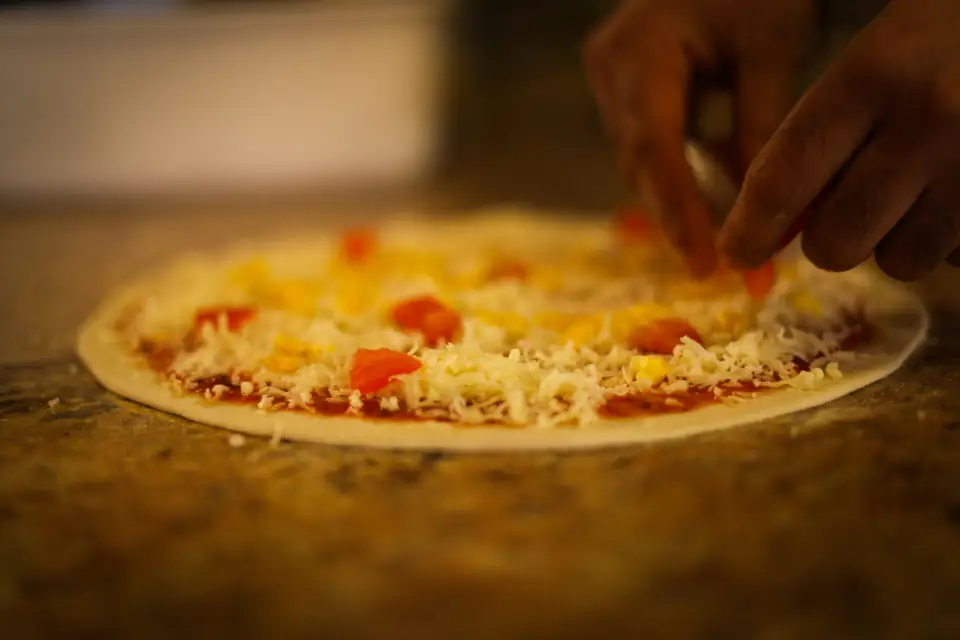
There is that moment when you stand in front of a freshly stretched base and want to pile on everything the fridge has to offer. Understandable. But the best pizzas almost always carry the least. A good base needs room to rise, heat that reaches it from above and below, and toppings that do not drown each other.
These are the rules we think matter most for great toppings, with the Margherita as the benchmark.
Rule 1: Less is more
Every topping adds weight, moisture and bulk. Too much of it presses the base flat, stops the rim from rising and turns the centre soggy. Two or three ingredients besides tomato and cheese are almost always enough. If you can no longer see the dough while topping, it is too much.
This matters even more in a very hot oven. For Pizza Napoletana, the EU specification gives a bake time of 60 to 90 seconds. Nothing piled thick will cook through in so short a time.
Rule 2: Keep moisture in check
The most common cause of a soggy pizza is water. It comes from three places:
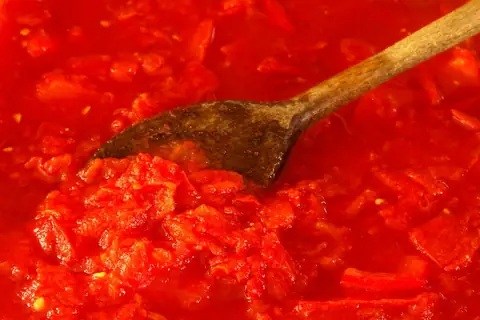
- Tomatoes: a thin layer is enough. If your sauce is very runny, let it drain briefly or simply use less. More in our article on tomato sauce for pizza.
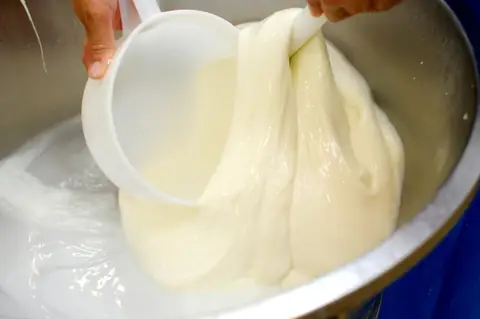
- Cheese: fresh mozzarella holds a lot of water. In the US, where the terms are legally defined, regular mozzarella may contain more than 52 and up to 60 % moisture, low-moisture mozzarella more than 45 and up to 52 %. Fresh mozzarella in brine releases plenty of liquid as it bakes. Which cheese suits what is covered in our article on mozzarella for pizza.
- Vegetables: mushrooms, courgette, peppers or spinach release water when heated. Slice them thinly or cook them briefly first.
Preparing mozzarella
Slice or tear fresh mozzarella into pieces, leave it in a sieve for a while and pat it dry before topping. Some people prepare it a few hours ahead and let it drain in the fridge. You keep the flavour, not the puddle.
Rule 3: Order matters
The classic order is tomato, cheese, other toppings, oil. The EU specification for Pizza Napoletana describes it in detail: the tomatoes go in the centre of the base and are spread in a spiral motion, followed by salt, mozzarella, basil and finally olive oil, distributed from the centre outwards. Leave the rim bare so it can rise.
For other toppings:
- On top of the cheese: ingredients that like some heat and browning, such as salami. It gets crisper there.
- Under the cheese: ingredients that dry out or burn easily, such as thinly sliced vegetables or cooked ham.
Rule 4: Some things go on after baking
Not everything can take full oven heat. Delicate, aromatic or raw ingredients lose colour, aroma or texture in the oven. They go on the finished pizza as it comes out.
| Ingredient | Before baking | After baking | Why |
|---|---|---|---|
| Tomato | yes | no | the base layer, should cook |
| Mozzarella | yes | no | should melt |
| Salami | yes | no | crisps up, releases fat |
| Basil | yes (classic Neapolitan) | a few extra leaves | aromatic when baked, fresh and green after |
| Extra virgin olive oil | yes | a few drops | keeps its fresh aroma |
| Prosciutto crudo | no | yes | turns dry and salty in the oven |
| Rocket | no | yes | wilts and turns bitter |
| Burrata, stracciatella | no | yes | should stay creamy |
| Parmesan or pecorino shavings | rather not | yes | stay aromatic and do not burn |
Rule 5: Know your quantities
For the Margherita there is an official benchmark: the "Pizza Napoletana TSG" specification in EU Regulation No 97/2010. It applies to a pizza no larger than 35 cm across, made from a 180 to 250 g dough ball.
| Ingredient | Margherita (TSG) | Marinara (TSG) |
|---|---|---|
| Crushed peeled tomatoes | 60 to 80 g | 70 to 100 g |
| Mozzarella (buffalo mozzarella PDO or mozzarella TSG) | 80 to 100 g | - |
| Extra virgin olive oil | 4 to 5 g | 4 to 5 g |
| Basil | a few fresh leaves | - |
| Garlic, oregano | - | yes |
For a 30 to 33 cm pizza these ranges are a good starting point. For other toppings such as salami there is no official weight. Our rule of thumb: a single layer with little overlap, so you can still see cheese between the slices.
Rule 6: Match toppings to your oven
A very hot pizza oven with a stone floor bakes a pizza in one to three minutes depending on the temperature, and at Neapolitan heat in just 60 to 90 seconds. A home oven takes considerably longer. That changes how you should top:
| Very hot pizza oven | Home oven | |
|---|---|---|
| Bake time | short, roughly 1 to 3 minutes depending on the oven | considerably longer, often several minutes |
| Raw toppings | barely cook, so slice thinly or precook | have more time to cook |
| Moisture | little evaporates, top sparingly | more evaporates, the base can still go soggy |
| Mozzarella | on from the start | can go on later so it does not brown too much or turn greasy |
In a home oven, a preheated pizza stone or steel on the top shelf helps. If you have little heat from below, top even more sparingly.
The Margherita as the benchmark
The Margherita is the most honest pizza there is. Tomato, mozzarella, basil, olive oil: none of them can hide a weak dough or a poor ingredient. If your Margherita works, every other pizza will too. That is why it is worth practising on: weigh the toppings, keep the order, look at the result, adjust.
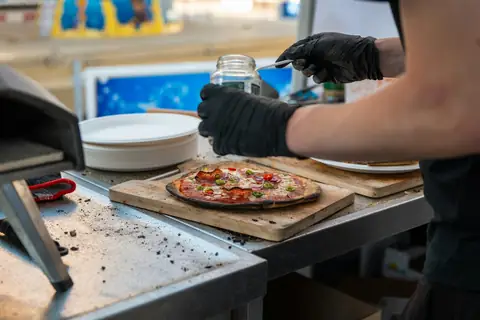
At TIAMO it is one of two classics on the menu, next to the Salami, and we think it tells you straight away whether everything is right. How to organise a topping station at a stand so things move quickly even with a long queue is covered in pizza at the market. And how the Margherita is eaten at home and in other regions is in our article on pizza in Italy.
The timeline
Frequently asked questions
How much tomato sauce goes on a pizza?
For a Margherita, the EU specification for Pizza Napoletana gives 60 to 80 g of crushed peeled tomatoes, and 70 to 100 g for a Marinara without cheese. That is a sound guide for pizzas up to about 33 to 35 cm.
Why is my pizza soggy in the middle?
Usually too much moisture, from too much sauce, wet mozzarella or raw vegetables. Use less sauce, drain the mozzarella and go easier on the toppings.
Does basil go on before or after baking?
On a classic Neapolitan Margherita it goes on before baking. If you like it fresh and bright green, add a few more leaves once the pizza is out of the oven.
Do I need to drain mozzarella?
With fresh mozzarella in brine it makes sense. Slice or tear it, leave it in a sieve for a while and pat it dry. Low-moisture mozzarella contains less water to begin with.
Does salami go under or on top of the cheese?
Either works. On top it gets crisper with slightly crunchy edges, under the cheese it stays softer and juicier.
Sources
- Commission Regulation (EU) No 97/2010 (Pizza Napoletana TSG), Annex II: specification, legislation.gov.uk (The National Archives) (legislation.gov.uk)
- International Regulations Verace Pizza Napoletana (2024), Associazione Verace Pizza Napoletana (pizzanapoletana.org)
- 21 CFR § 133.155 Mozzarella cheese and scamorza cheese, Legal Information Institute, Cornell Law School (law.cornell.edu)
- 21 CFR § 133.156 Low-moisture mozzarella and scamorza cheese, Legal Information Institute, Cornell Law School (law.cornell.edu)
We check facts against these sources. Spotted a mistake? Write to us and we will fix it.