Contents
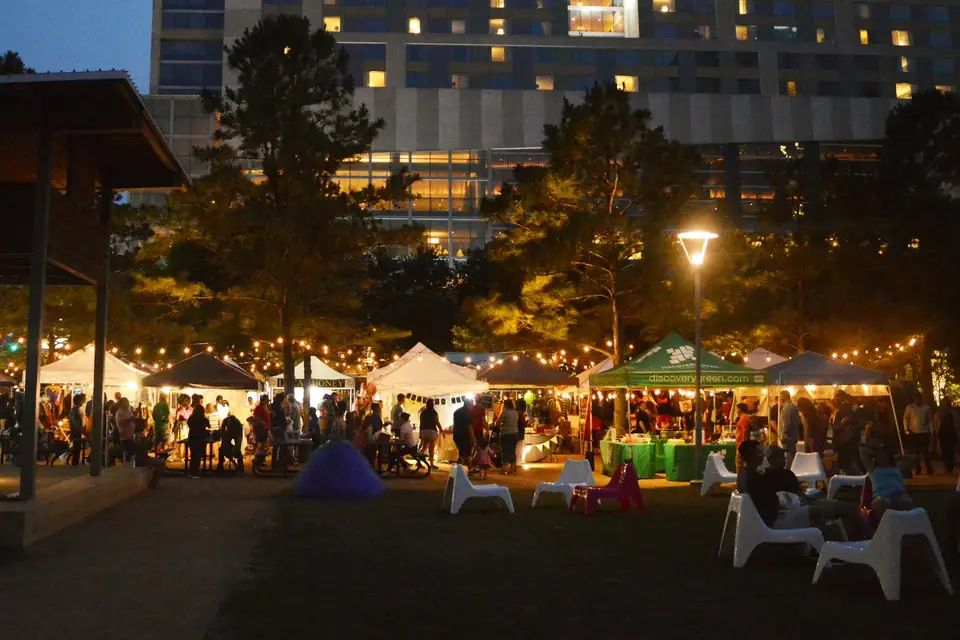
A pizza oven at a festival is a wonderful thing: the smell, the flames, people stopping to watch. At the same time you have an appliance running at several hundred degrees, often a gas cylinder, power cables, food and a crowd in a small space. At TIAMO we run a mobile pizza stand around Frankfurt, and for us great pizza and good safety go hand in hand. This article sums up the rules that typically apply in Germany.
Who has a say?
Several bodies are involved when you trade at an event:
- The organiser decides your pitch, the power supply, which fuels are allowed and often sets its own safety rules.
- The public order office and fire service check the safety concept, distances and escape routes, especially at larger events.
- Food control (usually the veterinary and food inspection office of the district or city) checks hygiene at the stand.
- The trade office handles business registration and, where needed, the itinerant trade licence.
- Your statutory accident insurer (Berufsgenossenschaft) is the contact for occupational safety if you employ staff.
Gas: running LPG safely
Many mobile pizza ovens run on propane from cylinders. For commercial use in Germany, the key reference today is DGUV Rule 110-010 "Use of LPG" (edition 12/2022, updated 11/2024). When it appeared, the DGUV recommended withdrawing the former DGUV Regulations 79 and 80. Whether the older regulation still applies with your insurer is best checked with them.
Inspection by a qualified person
Under DGUV Rule 110-010, an LPG installation must be inspected before first use and then at regular intervals, by a person qualified to inspect LPG installations or by an approved inspection body. For mobile LPG installations the rule sets a maximum interval of 2 years, the same as for installations in or on vehicles. Keep the inspection certificate at the stand; many organisers will want to see it.
Cylinders, regulators, hoses
The key points from the rule in brief:
- Outdoor placement comes first. Cylinders must not stand in tight recesses under 2 m² where leaking gas cannot disperse safely.
- Upright and stable: when gas is drawn from the vapour phase, cylinders must stand upright. Large 33 kg cylinders tip over easily and must be secured, for example with a chain.
- Leak check: every time a regulator or hose is connected to a cylinder, the joint is checked for leaks before use, for example with leak-detection spray.
- Hoses: generally no longer than 0.4 m. Longer hoses are only allowed for specific operational reasons, which the rule explicitly says include markets and fairs, and then with a hose-break safety device and routing protected against damage. Respect the hose's manufacturing date and service life, and never use home-made hoses with hose clamps.
- Hose-break protection: above ground level, a hose-break safety valve or a regulator with integrated hose-break protection is required.
- Distance to combustibles: distance or shielding must keep combustible parts from overheating. As a guide, the rule mentions a maximum of 85 °C on their surface.
Ventilation
Gas ovens belong outdoors or in well-ventilated areas, because combustion produces flue gases. Inside a closed tent or a trailer, ventilation and flue routing become a topic of their own that the DGUV rule covers in detail. Expert advice is worth it here.
Fire safety at the stand
Extinguishing equipment
Every stand with an open flame needs a suitable fire extinguisher within easy reach, not tucked behind the oven. For gas fires (fire class C), DGUV Rule 110-010 lists powder extinguishers with ABC or BC powder as examples. All extinguishers must be inspected at least every 2 years, with the inspection sticker as proof. A fire blanket is a sensible addition, for burning clothing or small fires on the work surface.
Distances and local requirements
How far the oven must be from tent walls, neighbouring stands and the public, whether a spark guard is required and where gas cylinders may be stored is usually set by the organiser together with the public order office and the fire service. These requirements differ between municipalities and sometimes between events. Get them in writing and plan your layout accordingly.
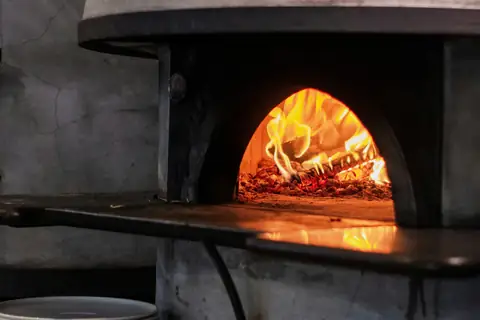
Wood-fired ovens: sparks, smoke and ash
A wood fire at a market needs extra care:
- Sparks: sparks from the flue or the oven mouth can ignite tent roofs, straw or decorations. Many sites only allow wood-fired ovens with conditions, or not at all.
- Firewood: only dry, untreated wood. Damp wood smokes heavily and bothers guests and neighbours.
- Ash and embers: ash often stays hot for a long time. It belongs in a non-combustible metal container with a lid, never in a bin or plastic bucket.
- Smoke: in wind, smoke can drift into neighbouring stands or homes. Think about your pitch and the wind direction.
Power: CEE, RCDs and testing
Electric ovens, fridges and cables have a hard life at a festival: rough handling, rain and foot traffic.
- Connection: larger ovens usually need a three-phase CEE connection. Your organiser will tell you what is available.
- Residual current protection (RCD): an RCD protects in case of insulation faults. Temporary installations at fairs and markets have their own requirements in the German standard series DIN VDE 0100 (part 740). Clarify in advance whether the organiser's distribution is already protected or whether you need your own distribution box with RCD.
- Cables: only cables rated for outdoor use, unwind cable reels fully, and protect cables in walkways with cable ramps.
- Testing: under DGUV Regulation 3 "Electrical installations and equipment", portable electrical equipment and leads must be tested regularly by a qualified electrician. Intervals follow from your risk assessment, and the implementation guidance gives reference values. Many organisers ask for proof in the form of test stickers.
Hygiene: food law at the stand
EU hygiene regulation
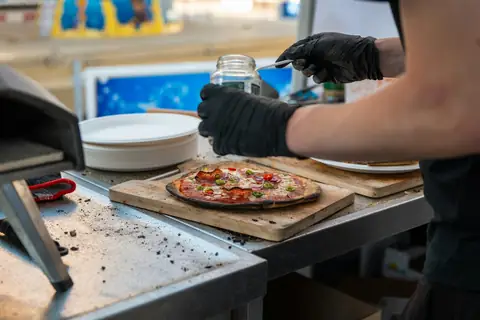
The basis is Regulation (EC) No 852/2004 on the hygiene of foodstuffs. For movable and temporary premises such as market stalls and mobile sales vehicles, its Annex II Chapter III applies. The German guideline for good hygiene practice in movable premises, published by the BGN and other associations, translates this into practice, for example:
- at least one easily accessible hand-wash basin with water of drinking quality and a way to dry hands hygienically,
- enough water for the whole trading period, including warm water when handling perishable foods,
- smooth, easy-to-clean work surfaces,
- protection of food from weather and pests, and a sneeze guard where needed,
- refrigeration and temperature checks for mozzarella, ham and other sensitive ingredients.
Food businesses must also be registered with the competent authority.
Briefing under the Infection Protection Act
Anyone working commercially with certain foods, including milk and dairy products and meat and meat products, or working in restaurant and catering kitchens, needs a certificate of the briefing under section 43 of the German Infection Protection Act before starting work, issued by the public health office or a doctor it has commissioned. The certificate must be no older than three months when work begins. After that, the employer must repeat the briefing every two years and document it. With a pizza topped with mozzarella and ham, you are covered by this very quickly.
Trade registration
A pizza stand is a business and must be registered. If you sell away from a fixed business location, you may also need an itinerant trade licence (Reisegewerbekarte) under section 55 of the German Trade Regulation Act. Section 55a provides exceptions for certain cases, for example selling at public festivals with the permission of the competent authority. Your trade office will tell you which applies to you.
Checklist before the event
| Area | What to sort out beforehand | Proof at the stand |
|---|---|---|
| Organiser | get written requirements on fuel, distances, power and extinguishers | approval, conditions letter |
| Gas | inspection by a qualified person (mobile installations at least every 2 years), check hoses and regulator | inspection certificate |
| Gas on site | cylinders upright and secured, leak check after every connection | leak spray at hand |
| Fire safety | suitable extinguisher, inspected (at least every 2 years), fire blanket | inspection sticker |
| Wood | spark guard, dry wood, lidded metal ash container | as required |
| Power | suitable cables, clarify RCD protection, equipment tested under DGUV Regulation 3 | test stickers |
| Hygiene | hand-wash basin, water supply, refrigeration, thermometer, registration | registration, temperature log |
| Staff | section 43 briefing for everyone handling food | certificates, briefing records |
| Trade | business registration, itinerant trade licence if needed | registration or licence |
Read on
Which oven suits your use in the first place is covered in buying a pizza oven: wood, gas or electric. How a market day at a pizza stand can run, from dough to the last slice, is in pizza at the market. And if you want to plan your dough so it is ready right on time, have a look at cold fermentation.
The timeline
Frequently asked questions
Is DGUV Regulation 79 on LPG still in force?
When DGUV Rule 110-010 "Use of LPG" was published, the DGUV recommended withdrawing DGUV Regulations 79 and 80. Whether it still applies with your accident insurer is something you should ask them directly.
How often must a mobile gas installation be inspected?
DGUV Rule 110-010 sets a maximum interval of 2 years for recurring inspections of mobile LPG installations, plus an inspection before first use. The inspection is done by a person qualified to test LPG installations.
Which fire extinguisher suits a gas pizza oven?
For gas fires (fire class C), DGUV Rule 110-010 names powder extinguishers with ABC or BC powder as examples. Extinguishers must be inspected at least every 2 years, and organisers may ask for additional equipment.
Do market staff need a food hygiene briefing in Germany?
Anyone working commercially with foods such as dairy or meat products needs a certificate of the briefing under section 43 of the Infection Protection Act before starting, no older than three months. The employer then repeats the briefing every two years.
Is this article legal advice?
No. It gives an overview of typical rules in Germany. What counts are the requirements of your organiser and the local authorities, which can differ considerably between municipalities.
Sources
- DGUV Regel 110-010 Verwendung von Flüssiggas, German Social Accident Insurance (DGUV) (publikationen.dguv.de)
- Checkliste zur Gefährdungsbeurteilung gemäß DGUV Regel 110-010, German Social Accident Insurance (DGUV) (publikationen.dguv.de)
- DGUV Vorschrift 79 Verwendung von Flüssiggas, German Social Accident Insurance (DGUV) (publikationen.dguv.de)
- DGUV Vorschrift 3 Elektrische Anlagen und Betriebsmittel, German Social Accident Insurance (DGUV) (publikationen.dguv.de)
- Leitlinie für eine gute Lebensmittelhygienepraxis in ortsveränderlichen Betriebsstätten, BGN, German Association of Food Inspectors and others (bgn-branchenwissen.de)
- Infektionsschutzgesetz § 42, German Federal Ministry of Justice (gesetze-im-internet.de) (gesetze-im-internet.de)
- Infektionsschutzgesetz § 43, German Federal Ministry of Justice (gesetze-im-internet.de) (gesetze-im-internet.de)
- Gewerbeordnung § 55 Reisegewerbekarte, German Federal Ministry of Justice (gesetze-im-internet.de) (gesetze-im-internet.de)
We check facts against these sources. Spotted a mistake? Write to us and we will fix it.