Contents
- What is cold fermentation?
- What happens inside the dough
- How much yeast for 24, 48 and 72 hours
- How cold is your fridge?
- Dough balls or bulk in the fridge?
- Containers
- Before baking: tempering
- Signs of over-proofed dough
- Dough schedule: pizza on Saturday at 6:00 pm
- Cold fermentation for event catering
- The bottom line
Mix on Wednesday, bake on Saturday? It sounds like a detour, but it is one of the easiest upgrades you can give your pizza. Cold fermentation, a long, slow rest in the fridge, makes dough tastier and nicer to handle, and it takes the time pressure off. Here is what happens in the fridge, how much yeast you need and how to plan your bake down to the hour.
What is cold fermentation?
Instead of rising for a few hours at room temperature, the dough matures for one to three days in the fridge, typically at 3 to 6 °C. It then comes back up to room temperature, gets stretched and goes into the oven. Bakers also call this retarding. In our articles we use proofing for the whole period in which the dough ferments and rises.
What happens inside the dough
Yeast slows down but keeps going
Yeast is fast when warm and slow when cold. America's Test Kitchen showed this neatly: a room-temperature batch inflated a balloon within three hours and then stalled because the yeast had used up its sugars. The refrigerated batch was still working after 18 hours. That is the whole idea: the yeast releases gas and aroma compounds steadily over a long period instead of sprinting through its food in a few hours.
Enzymes stay busy
Flour contains enzymes that break starch and protein into smaller pieces. The AVPN rulebook describes this maturation ("maturazione") as a process in its own right alongside fermentation: the dough becomes less tough, more extensible and easier to shape. Some of the starch also ends up as sugars that help the crust brown later.
More flavour
A longer maturation gives flavour more time to build. That is exactly why America's Test Kitchen often ferments dough in the fridge for 24 to 48 hours, sometimes 72. The result tastes rounder and slightly nutty, and less like raw flour.
And you get time back
Perhaps the most underrated benefit: cold dough is patient. Whether you bake at 6:00 pm or 6:45 pm hardly matters. With a warm, heavily yeasted dough, those 45 minutes can be the difference between perfect and over-proofed.
How much yeast for 24, 48 and 72 hours
The longer the dough stays cold, the less yeast it needs. Our dough calculator uses these guide values for fresh yeast, as a percentage of flour weight, based on a fridge at about 4 °C plus roughly 2 hours at room temperature before baking:
| Schedule | Fresh yeast (of flour) | Per 1 kg flour | Dry yeast (approx. 1/3) |
|---|---|---|---|
| 24 h cold + 2 h warm | approx. 0.25 % | approx. 2.5 g | approx. 0.8 g |
| 48 h cold + 2 h warm | approx. 0.15 % | approx. 1.5 g | approx. 0.5 g |
| 72 h cold + 2 h warm | approx. 0.1 % | approx. 1 g | approx. 0.3 g |
| for comparison: 8 h at 22 °C | approx. 0.25 % | approx. 2.5 g | approx. 0.8 g |
Treat these as starting points. Flour, water temperature, your fridge and your kitchen will all nudge the result. Make a note of how the dough behaved the first time and adjust next time. For yeast types and conversions, see yeast or sourdough for pizza?.
How cold is your fridge?
Fridges differ, and so do the zones inside one. Germany's consumer testing organisation Stiftung Warentest gives these typical values:
| Zone | Temperature (typical) | For pizza dough |
|---|---|---|
| Glass shelf above the crisper | approx. 2 to 4 °C | slowest fermentation, good for 72 h |
| Middle shelf | approx. 5 to 7 °C | faster, consider less yeast |
| Top shelf | approx. 8 to 10 °C | too warm for long schedules |
| Door | warmest area | not suitable |
A cheap fridge thermometer is money well spent. If your dough keeps rising faster than expected, your fridge is probably warmer than you think: use less yeast or shorten the schedule. Also bear in mind that a big, warm mass of dough takes hours to chill to the core, while individual dough balls cool down much faster.
Dough balls or bulk in the fridge?
There are two common approaches.
Ball first
After mixing, let the dough rest briefly, divide it into dough balls (about 250 g for Neapolitan style) and refrigerate them straight away. The cold rest then doubles as the final proof. This is the simplest method, the balls chill quickly, and on baking day you only need to bring them up to temperature. It is also the sequence our calculator model assumes.
Bulk first, divide later
You refrigerate the whole batch in one large tub (bulk fermentation) and shape the balls on baking day. The upside is flexibility: you decide on the day how many pizzas and what size. The downside is that freshly shaped balls are tight and need more time before they stretch nicely, so allow more than the 2 hours in the table.
Containers
- Airtight. Dough left uncovered forms a dry skin that refuses to stretch later.
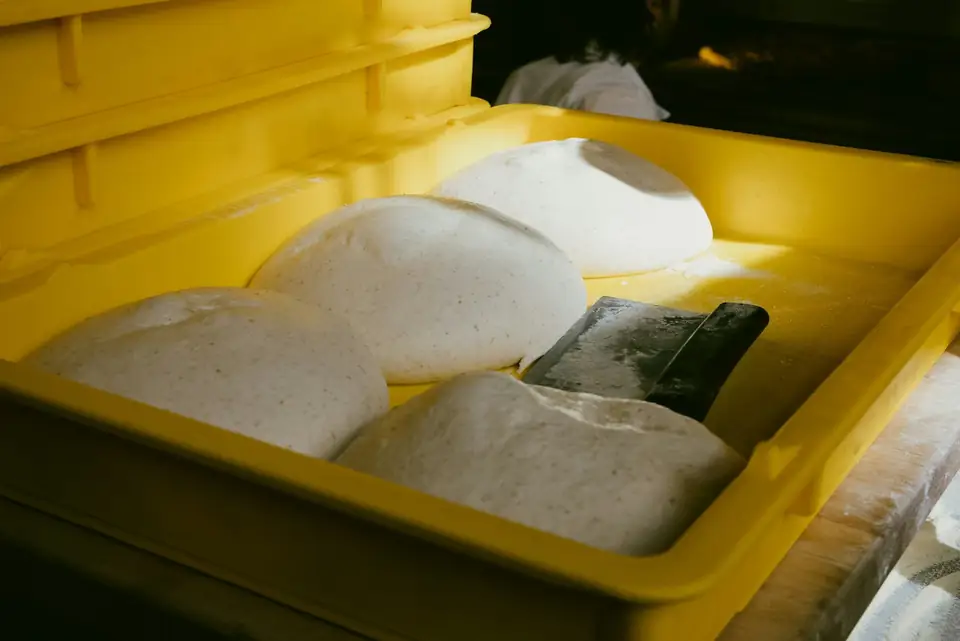
- Room to grow. Dough still rises in the fridge. Leave space between balls or they will merge.
- Lightly oiled. A film of oil in the container or on the ball helps it release cleanly.
- Practical options: individual lidded tubs for a few pizzas, flat dough-ball trays with lids for bigger batches.
Before baking: tempering
Cold dough is firm, springy and tears easily, so it needs to come back up to room temperature first. As a guide we allow about 2 hours at 20 to 22 °C. In a cool cellar or outdoors in autumn it can take longer, in midsummer less.
A ball is ready when it feels soft and relaxed, has risen a little and stretches without snapping back. King Arthur Baking describes the poke test: press a lightly floured finger about 2 to 3 cm (roughly an inch) into the dough. If the dent pops straight back out, it needs more time. If it largely stays, it is ready. If the dough feels fragile or collapses, it has gone too far. On cold dough the test tells you very little, so do it after tempering.
Signs of over-proofed dough
- Balls have spread out flat and run into each other.
- Lots of large bubbles under a thin, fragile surface.
- The dough tears when stretched instead of extending.
- A strong smell of alcohol or a distinctly sour note.
- The crust browns poorly because the yeast has eaten too much sugar.
Mildly over-proofed dough can often still be baked if handled gently, for example as a thin, crisp pizza. Next time use less yeast, a colder spot in the fridge or a shorter schedule. Our dough troubleshooting guide covers more causes and fixes.
Dough schedule: pizza on Saturday at 6:00 pm
The trick is to plan backwards. Here is a schedule based on our calculator's guide values for the first pizza going into the oven on Saturday at 6:00 pm:
| Schedule | Fresh yeast | Mix | Balls into the fridge | Out of the fridge | Bake |
|---|---|---|---|---|---|
| 72 h cold | approx. 0.1 % | Wednesday approx. 3:30 pm | Wednesday approx. 4:00 pm | Saturday 4:00 pm | Saturday 6:00 pm |
| 48 h cold | approx. 0.15 % | Thursday approx. 3:30 pm | Thursday approx. 4:00 pm | Saturday 4:00 pm | Saturday 6:00 pm |
| 24 h cold | approx. 0.25 % | Friday approx. 3:30 pm | Friday approx. 4:00 pm | Saturday 4:00 pm | Saturday 6:00 pm |
| no fridge, 8 h at 22 °C | approx. 0.25 % | Saturday approx. 9:30 am | - | - | Saturday 6:00 pm |
Do not forget the oven. A stone or steel in a home oven needs about an hour to preheat, and a pizza oven needs its own warm-up too, so switch it on when the dough comes out of the fridge. For the base recipe, see our guide to the perfect pizza dough.
Cold fermentation for event catering
For many mobile pizza stands, cold fermentation is a cornerstone of the routine. If you are baking at a Saturday festival or a wedding, you cannot mix that morning and simply hope the kitchen stays at the perfect temperature. With a cold schedule, the dough is made calmly days in advance, matures under control and is exactly where it should be when service starts. It also raises new questions: how to transport dough balls chilled, how to temper them when it is 30 °C or 5 °C outside, and how to stagger trays over a long evening. Read more about how a market day works in pizza at the market.
The bottom line
Cold fermentation is the simplest lever for better pizza: less yeast, more time, more flavour and a dough that does not dictate your day. Pick your timing, match the yeast, give the dough a cold spot in a well-sealed box and allow about 2 hours to temper. Then on Saturday at 6:00 pm a relaxed dough will be waiting for you, not the other way round.
The timeline
Frequently asked questions
How long can pizza dough stay in the fridge?
24 to 72 hours is typical. The key is matching the yeast to the timing, otherwise a three-day dough will be over-proofed.
How long should dough sit out before baking?
Roughly 2 hours at room temperature as a guide, longer in a cool room. It should feel soft and relaxed and stretch easily.
What temperature should my fridge be?
Our calculator assumes about 4 °C. Many fridges run 5 to 7 °C on the middle shelf, in which case the dough moves faster, so use a little less yeast or a shorter schedule.
Should I refrigerate dough balls or the whole batch?
Both work. Balling right after mixing and chilling the balls individually is simplest. If you chill the whole batch, allow time on baking day to divide and let the balls relax.
How do I know if dough is over-proofed?
It is slack, spread out, full of large bubbles, tears when stretched and smells strongly of alcohol or sour. In the poke test it feels fragile and collapses.
Sources
- Cold Fermentation and Flavor in Yeasted Breads, America's Test Kitchen (americastestkitchen.com)
- International Regulations for obtaining the collective trademark Verace Pizza Napoletana (Disciplinare 2024, English version), Associazione Verace Pizza Napoletana (AVPN) (pizzanapoletana.org)
- Kühlschrank richtig einräumen: 7 Tipps, wie Ihre Lebensmittel länger frisch bleiben, Stiftung Warentest (test.de)
- How to tell if bread dough has risen enough, King Arthur Baking (kingarthurbaking.com)
We check facts against these sources. Spotted a mistake? Write to us and we will fix it.