Contents
Flour, water, salt and yeast are all a good pizza dough needs. Yet one early step decides whether your dough later stretches like silk or tears: kneading. Whether you use a spiral mixer, a planetary mixer, a fork mixer or simply your hands is less a matter of belief than of batch size, space, power supply and patience.
This guide explains what actually happens in the dough, how the machine types differ, what to look for when buying and what you really need for a home kitchen, a small market stand or a pizzeria. You will not find best-buy lists or model recommendations here, on purpose.
What kneading does
Gluten: the dough's framework
Wheat flour contains two groups of proteins, gliadins and glutenins. Once they meet water, they bond into gluten. Put simply, glutenins bring strength and elasticity, gliadins bring extensibility. Together they form a network that traps the gas produced by the yeast and gives the dough its structure.
Water alone does not quite get you there. Mechanical work - kneading, stretching, folding - spreads the proteins evenly, lines them up and links the network. Time helps too: when dough rests after mixing, the flour keeps hydrating and gluten partly develops on its own. That is the idea behind the autolyse, where flour and water sit for a while before the actual kneading.
How to tell the dough is ready
Well-kneaded pizza dough is smooth, mostly clears the sides of the bowl and springs back slowly when you press it. A classic check is the windowpane test: gently stretch a small piece. If it gets thin enough to let light through before tearing, the gluten network is well developed. Pizza dough does not need to be kneaded as far as a soft sandwich loaf, because the long fermentation keeps working for you.
If your dough is sticky, tears or keeps shrinking back, kneading is only one of several suspects, alongside flour, water content and fermentation. Our dough troubleshooting guide and hydration explained go into more detail.
Dough temperature: the overlooked variable
Kneading creates friction, and friction creates heat. The faster and longer a machine runs and the more dough is in the bowl, the warmer the dough gets. The dough temperature at the end of mixing then sets how fast the yeast gets going and how the dough behaves over the next hours. Too warm and it races ahead, too cold and it barely moves.
What to aim for
For wheat doughs, King Arthur Baking gives a desired dough temperature of 75 to 78 °F at the end of mixing, roughly 24 to 26 °C. Doughs that go into a long cold ferment can be a little cooler. That range is a sound starting point for pizza. More important than hitting an exact number is measuring consistently (probe thermometer, centre of the dough, right after mixing) and matching your recipe, especially the amount of yeast, to it.
The water temperature formula
You can barely influence flour and room temperature, but you control the water. The standard rule for a straight dough without a preferment is:
Water temperature = (target dough temperature × 3) - flour temperature - room temperature - friction factor
With a preferment such as poolish, multiply by 4 and also subtract the preferment temperature. The formula works in Celsius exactly as in Fahrenheit; just convert friction factors correctly (a Fahrenheit difference divided by 1.8 gives the Celsius difference).
| Input | Example value |
|---|---|
| Target dough temperature | 24 °C (× 3 = 72) |
| Flour temperature | 20 °C |
| Room temperature | 22 °C |
| Mixer friction factor (example, measured yourself) | 10 °C |
| Water temperature | 72 - 20 - 22 - 10 = 20 °C |
The numbers in the table are a worked example, not a recommendation for your machine.
Measuring your own friction factor
The friction factor is the hardest number in the equation, because it depends on mixer type, mixing time, speed and batch size. As a reference, King Arthur Baking gives about 6 to 8 °F (roughly 3 to 4.5 °C) for about eight minutes of mixing and kneading by hand, and 22 to 24 °F (roughly 12 to 13 °C) for a particular stand mixer with a dough hook. For your own machine:
- Mix a test batch and write down mixing times and speeds.
- Measure the dough temperature right after mixing.
- Multiply that temperature by 3.
- Subtract flour, room and water temperature. What is left is your friction factor.
If you change batch size or mixing time significantly, measure again. That is how your dough comes out the same in July as in January.
The machine types
Spiral mixer
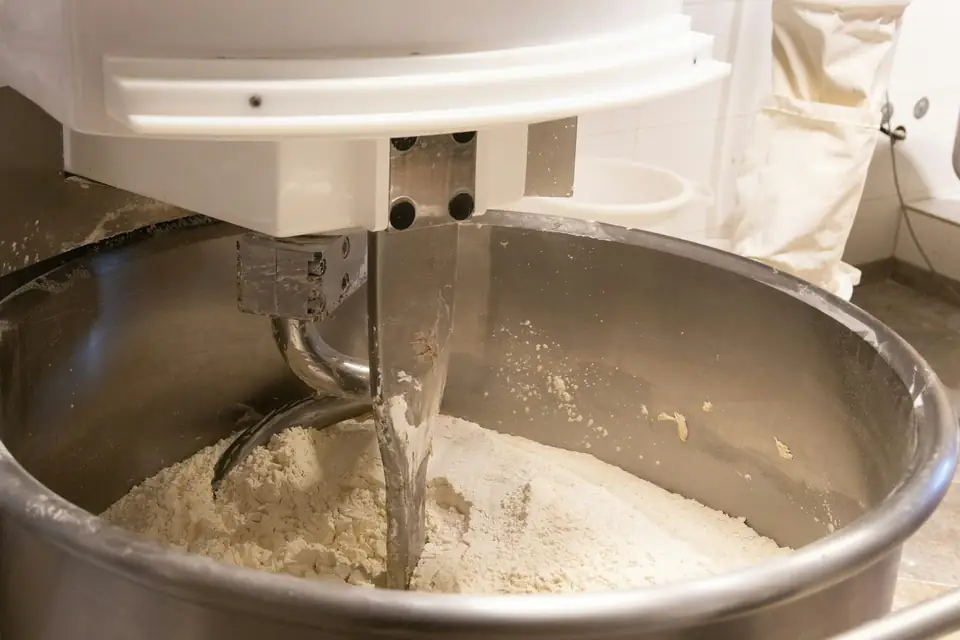
In a spiral mixer a spiral-shaped hook turns while the bowl rotates as well. The dough is constantly guided through the hook, stretched and folded. Many models have two speeds: a slow one to combine, a faster one to develop the dough. Spiral mixers are widespread in pizzerias and bakeries because they handle both firm and softer doughs evenly in larger quantities.
In Europe, dough mixers with a rotating bowl, spiral mixers included, are covered by the standard EN 453, which sets safety and hygiene requirements for bowls holding 5 to 500 litres. Household appliances are excluded.
Planetary mixer
In a planetary mixer the bowl stays still. The tool spins on its own axis and at the same time orbits the centre of the bowl, like a planet around the sun. The big advantage is versatility: dough hook, paddle and whisk are interchangeable, so one machine handles dough, cream and pastry. The typical home stand mixer works this way; commercial planetary mixers come much larger and fall under their own standard (EN 454).
For small batches of pizza dough a planetary mixer does the job. With firm doughs and a full bowl, smaller household machines reach their limits quickly, so always stay within the maximum dough quantity the manufacturer gives.
Fork and diving-arm mixers
A fork mixer uses a fork-shaped tool set at an angle into a rotating bowl. A diving-arm mixer (also called a plunging or double-arm mixer) has arms that alternately dip into the dough and lift it, a bit like two hands. Both work more slowly and are known for gentle kneading, at the cost of longer mixing times.
Worth knowing: the EU specification for "Pizza Napoletana TSG" (Commission Regulation (EU) No 97/2010) describes kneading the dough for 20 minutes at low speed in a mixer. The German version of the text names a fork mixer as the preferred type, while the English version speaks of a dough hook. Either way, this applies to that protected speciality, not to every pizza.
Kneading by hand
Your hands have the lowest friction factor and the best feel for the dough. For a handful of pizzas they are all you need. With higher hydration, meaning more water in the dough, two techniques work well:
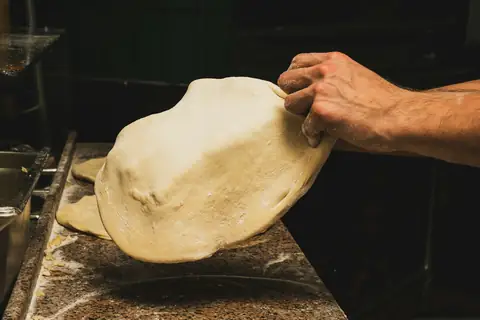
- Slap and fold: lift the dough by one end, let it hang, slap it gently onto the counter, fold it over itself and lift again from the same side. Do not slap too hard, and keep the surface clean with a bench scraper. After a few minutes the dough holds together noticeably better.
- Stretch and fold: grab one side of the dough, pull it up and lay it over the top, turn the bowl and repeat for all four sides. Do this in several rounds with breaks of about 20 to 30 minutes. The time in between does part of the work.
A short rest after the first mix makes hand kneading much easier. Our base recipe, the perfect pizza dough, walks you through making dough by hand step by step.
What to look for when buying
Capacity: flour, dough or litres?
Manufacturers state size in different ways: bowl volume in litres, maximum flour or maximum dough. That is a big difference, so do the maths yourself:
Dough weight ≈ flour weight × (100 % + hydration + salt + oil) / 100 %
With our reference values for a market dough (62 % hydration, 2.5 % salt, 1 % oil), the dough weighs about 1.65 times the flour. Ten dough balls of 250 g each mean 2.5 kg of dough and roughly 1.5 kg of flour. Our dough calculator works out the exact amounts.
Just as important is the minimum batch. With too little dough in the bowl it simply wraps around the hook or is not picked up properly. If you mostly make small batches, an oversized machine costs you more than space: it also gives you worse dough. The minimum is usually listed in the manual or data sheet, as is the reduced maximum for very soft doughs.
One speed or two
Two speeds are handy: mix slowly so the flour does not fly, then knead faster. A single speed works too, it just takes longer. Keep in mind that more speed means more friction and warmer dough, so fast kneading calls for colder water.
Fixed or removable bowl
A fixed bowl is robust and usually cheaper, but you have to empty and clean it inside the machine. A removable bowl, often combined with a tilting head, makes emptying and cleaning much easier, especially when you mix several batches in a row.
Power supply: 230 V or 400 V
Small and medium mixers are often available for a standard 230 V outlet. Larger machines frequently run on 400 V three-phase power, and some models only come that way. Check which outlet you really have in your kitchen or production space and how it is fused. If you want to knead on site, ask the event organiser in advance what supply is available at your pitch.
Hygiene and cleaning
Dough residue dries fast. Smooth surfaces, few corners, an accessible bowl and a removable guard or lid make daily cleaning easier. EN 453 explicitly covers hygiene as well as safety for dough mixers. Only clean the machine when it is switched off and unplugged, and follow the manufacturer's cleaning instructions, especially regarding water near the motor and electrics.
Safety
A mixer is strong enough to seriously injure fingers and hands. According to the German accident insurer BGN, access to the danger zones in the bowl must be prevented, for example by a fixed lid or a guard interlocked with the drive. Once the guard is opened, the tool may run on for no more than 4 seconds with an empty bowl; otherwise the lid has to stay locked until everything has stopped. In practice: never bypass safety devices and never reach into a running bowl.
Noise and placement
A mixer at high speed is clearly audible, and a heavy machine vibrates. Plan a stable, level spot with enough room to unload the bowl. For commercial machines, the manual lists the noise emission.
Comparison at a glance
| Criterion | Spiral mixer | Planetary mixer | Fork / diving-arm mixer | Hands |
|---|---|---|---|---|
| Principle | bowl and spiral both turn | bowl still, tool orbits | slow tool in a rotating bowl | stretch, fold, slap |
| Strength | large batches of bread and pizza dough | versatile, interchangeable tools | very gentle | full control, no equipment |
| Weakness | dough only, mind the minimum batch | quickly at its limit with firm dough and a full bowl | slower, big and heavy | time and effort, small batches only |
| Friction heat | medium, depends on speed and time | depends on machine and batch, measure it | low to medium | low |
| Typical use | pizzeria, food business, bakery | home, pastry kitchen, small batches | pizzeria, bakery | home |
What you really need
At home
For two to six pizzas at the weekend you do not need a machine. Hands, a bowl, a bench scraper and some patience are enough. If you already own a stand mixer, use it, but respect the maximum load and mixing time so the dough does not overheat. A small spiral mixer only pays off once you regularly make larger batches.
For a small market stand
What counts most is that capacity and minimum batch match your typical batch. Work out how many dough balls you need on a normal day and on a busy one, and whether you would rather mix one large batch or two smaller ones. Add to that the power supply in your production kitchen, a bowl that is easy to clean and enough fridge space for the dough balls afterwards. How this fits into planning a market day is covered in pizza at the market.
For a pizzeria
Pizzerias typically use a spiral or fork mixer, often on 400 V, with a capacity that covers the day's dough in one or two batches. A removable bowl saves cleaning time. Work with your machine's friction factor and check the dough temperature every time, especially in summer.
Prices
Prices vary widely depending on type, bowl size, features and manufacturer, from a home stand mixer to a commercial spiral mixer for a pizzeria. Compare current offers and keep the points above in mind: capacity, minimum batch, power supply and cleaning (as of October 2026).
And then?
The best mixer will not help much if the oven does not keep up. If you are planning your equipment, also read our pizza oven buying guide. And if your dough still does not behave despite a good machine, the dough troubleshooting guide will help.
The timeline
Frequently asked questions
Do I need a mixer for pizza dough at home?
No. With a short rest after mixing and a few rounds of stretch and fold you can make an elastic dough by hand. A machine mainly saves time and effort once you regularly make larger batches.
What is the difference between a spiral mixer and a planetary mixer?
In a spiral mixer both the bowl and the spiral hook turn, so the dough keeps passing through the hook. In a planetary mixer the bowl stays put and the tool also orbits around the bowl, which lets you swap in a whisk or a paddle.
What temperature should pizza dough be after mixing?
For wheat doughs, about 24 to 26 °C (75 to 78 °F) at the end of mixing is a common target. For a long cold ferment it can be a little cooler. What matters most is measuring the same way every time and adjusting your recipe to it.
How do I calculate the right water temperature?
Multiply your target dough temperature by 3, then subtract the flour temperature, the room temperature and your mixer's friction factor. The result is your water temperature. Find the friction factor with a test batch.
What do flour capacity and dough capacity mean?
Some manufacturers state how much flour fits in the bowl, others how much finished dough. For a dough with 62 % hydration, 2.5 % salt and 1 % oil, the dough weighs roughly 1.65 times the flour, so the difference is big. Also check the minimum batch, below which the machine will not knead properly.
Is a 230 V machine enough or do I need three-phase power?
Small and medium mixers are often available for 230 V, while larger machines frequently run on 400 V three-phase. Check which outlet is actually available in your kitchen or at your pitch before you buy.
Sources
- Dough Temperature, King Arthur Baking (Pro Reference) (kingarthurbaking.com)
- Desired dough temperature, King Arthur Baking (Blog) (kingarthurbaking.com)
- Kneading wet dough by hand, King Arthur Baking (Blog) (kingarthurbaking.com)
- ASI 2.11 Teigknetmaschinen: 4. Schutzmaßnahmen, BGN (German Social Accident Insurance for the food and hospitality sector) (vorschriften.bgn-branchenwissen.de)
- EN 453: Food processing machinery - Dough mixers - Safety and hygiene requirements, DIN Media (dinmedia.de)
- Commission Regulation (EU) No 97/2010, Annex II: Pizza Napoletana TSG specification, legislation.gov.uk (The National Archives) (legislation.gov.uk)
We check facts against these sources. Spotted a mistake? Write to us and we will fix it.
Independent: no advertising, no affiliate links, no paid recommendations.