Contents
Everyone who makes pizza dough knows those days: the dough sticks to everything, tears as you stretch it, or sits just as flat in the bowl after hours as when you started. No need to despair. Dough is alive, and almost every problem has a cause you can track down. In this guide we go through the most common faults one by one: what you see, what causes it and what to do differently next time.
All faults at a glance
| Problem | Common cause | What helps |
|---|---|---|
| Very sticky dough | under-kneaded, too warm, too much water for the flour | keep kneading, cooler water, slightly lower hydration |
| Dough tears when stretched | weak gluten, weak flour, overproofed, too cold | knead longer, stronger flour, adjust fermentation, temper |
| Dough shrinks back | tense gluten, dough ball too cold or freshly shaped | rest covered for 15 to 30 minutes |
| Dough does not rise | too little or damaged yeast, too cold, salt directly on yeast | check yeast, warmer spot, more time |
| Dough overproofed | too much yeast, too warm, too long | less yeast, cooler or shorter fermentation |
| Pale crust | oven too cold, overproofed, lots of bench flour | preheat hotter, shorten fermentation, shake off flour |
| Burnt base, raw top | floor hotter than dome | heat dome longer, lift the pizza |
| Gum line under toppings | wet sauce or toppings, cold floor, topped pizza waiting | less and thicker sauce, hotter floor, bake at once |
| Huge bubble in the middle | gas trapped, centre not pressed flat | press the centre more firmly, pop bubbles |
The numbers in this article match the presets of our dough calculator: around 60 % hydration and 2.8 % salt for Neapolitan, or 62 % hydration, 2.5 % salt and 1 % oil for pizza from a mobile high-heat oven.
Sticky dough
Sticky dough is the most common complaint, especially when you are starting out. It is almost always one of three things:
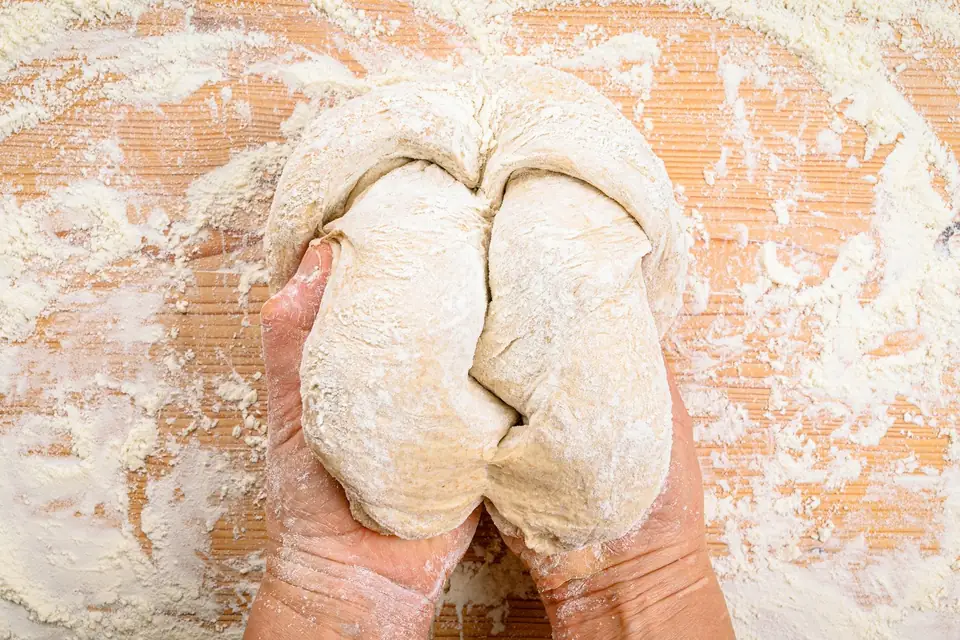
- Not kneaded enough yet. Freshly mixed dough always sticks. Only once the gluten has developed does it turn smooth and release from hands and bowl. Do not reach for flour straight away; keep kneading. A short rest of 10 to 15 minutes often helps more than a handful of flour.
- Too warm. Warm dough goes soft and sticky, and the yeast speeds up. Use cooler water and keep an eye on the dough temperature.
- Too much water for the flour. Not every flour absorbs the same amount of water. A weaker flour struggles at 65 %, while a strong pizza flour handles it well. Drop the water by two or three percentage points or choose a flour with more protein. More on this in hydration explained and flour types for pizza.
When shaping, lightly floured hands and a lightly floured bench are fine. But if you keep working in more flour, the dough changes, and loose flour can burn in the oven.
Dough tears
If the dough tears as you stretch it, the gluten network is not strong enough or has already weakened again.
- Under-kneaded: do the windowpane test. Stretch a small piece of dough thin. If it turns almost translucent without tearing straight away, the gluten is well developed.
- Flour too weak for the fermentation: for 24 hours or more you need a flour that can last that long. Which flours work is covered in flour types for pizza.
- Overproofed: with too long or too warm a fermentation the gluten breaks down. The dough goes slack and tears at thin spots. More on that below.
- Too cold: dough straight from the fridge is stiff. After cold fermentation, allow about two hours at room temperature.
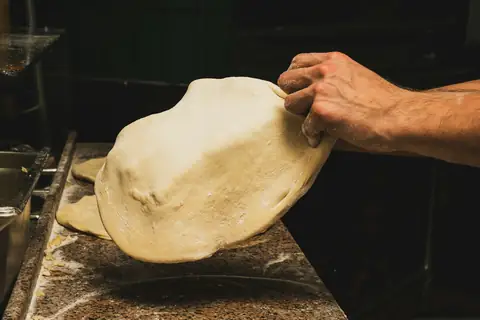
- Rough handling: press the dough ball out from the centre with your fingertips and stretch it gently over the backs of your hands rather than pulling at the edges.
Dough shrinks back
You stretch it to 30 cm, let go and it snaps back to 20. The culprit is tense gluten. Kneading, folding and shaping all strengthen the gluten network, sometimes so much that the dough fights back. King Arthur Baking's advice is simply to give it time: cover it, walk away for about 15 minutes or longer, then carry on.
You can prevent this by shaping the dough balls early enough so they relax during the final proof. And again: a cold dough ball shrinks back far more than one at room temperature.
Dough does not rise
Hours have passed and nothing has happened? Check these points:
- Yeast: is it fresh and within date? Fresh yeast should be pale and crumbly, not brown and smeary. Very hot water can damage yeast.
- Amount versus time: long fermentations need very little yeast, around 0.1 % fresh yeast relative to the flour for 24 hours at 20 °C. Use that amount in a cool kitchen or for a short fermentation and you will wait in vain. Our dough calculator adjusts the amount to time and temperature.
- Temperature: cold slows yeast down a lot. In a 16 °C kitchen everything takes considerably longer than at 22 °C.
- Salt directly on yeast: salt draws water out of yeast cells. The AVPN rules therefore say salt and yeast should not be in direct contact for more than 5 minutes. Dissolve them separately or add them one after the other.
- Straight from the fridge: after cold fermentation, dough seems sluggish at first. It needs time at room temperature before it comes alive.
Overproofed dough
The opposite is just as annoying. Overproofed dough smells clearly of alcohol, feels very soft and sticky, shows big bubbles on the surface and collapses when you handle it. The poke test gives you certainty: press a dent into it with your finger. If it springs back slowly, the dough is ready. If it just stays, it is overproofed, as Modernist Cuisine puts it.
Causes: too much yeast, too warm, too long. Often it is a combination, such as a 20 °C recipe on a 28 °C summer day.
Rescue: Modernist Cuisine describes a simple method: press the dough down, reshape it and let it proof again for a shorter time. It works with pizza dough too, although the crust may bake paler. Next time: reduce the yeast, ferment cooler or switch to cold fermentation.
Pale crust
Crust browning comes mainly from the Maillard reaction, in which sugars and proteins react under heat. It needs dry, high heat and fermentable sugars in the dough. If your crust stays pale, it is usually one of these:
- Oven too cold: the most common reason. Preheat longer and measure the floor temperature.
- Overproofed: the yeast has used up much of the sugar, leaving less for browning.
- Lots of bench flour: a thick layer of flour looks dull and may burn rather than brown. Shake off excess flour before topping.
- Style does not match the oven: Neapolitan dough without oil or sugar is meant for very hot ovens. In a home oven at 250 °C, a little oil and a touch of sugar help, as in our New York preset with 2 % oil and 1 % sugar.
Burnt base, raw top, or the other way round
If the base is black before the cheese has melted, the balance between bottom and top heat is off. In physics terms, the floor passes on heat by conduction and the dome by radiation. In their paper on the physics of pizza, Varlamov, Glatz and Grasso show how much the floor material matters: on steel, the underside gets far hotter than on brick at the same oven temperature.
Base too dark, top raw:
- Let the dome heat up properly, not just the floor.
- Move the pizza to a slightly cooler part of the floor.
- Towards the end, lift the pizza off the floor with the peel and hold it under the dome. The paper describes exactly this trick for wet toppings.
- With a steel in a home oven: adjust the temperature or the distance to the grill.
Top done, base pale:
- Preheat the stone longer. A pizza stone takes much longer to heat through than the oven air.
- Wait a moment between pizzas so the floor can recover.
More about oven types, floor materials and heat is in buying a pizza oven.
Gum line under the toppings
The dreaded gum line is a thin, damp, underbaked layer right under the sauce and cheese. Typical causes:
- Too much or too watery sauce: the water soaks into the dough before it can bake.
- Wet toppings: fresh vegetables, poorly drained mozzarella.
- Topped pizza left waiting: moisture has time to soak in. Top just before launching.
- Floor too cold: without enough bottom heat, the dough does not bake through from below fast enough.
- Centre too thick: press the middle thin and leave the rim standing.
A huge bubble in the middle
An airy rim full of bubbles is what you want; a giant bubble in the middle of the pizza is not. It forms when gas stays trapped in the centre of the dough ball. When shaping, press the centre flat firmly and push the air towards the rim. You can flatten visible big bubbles with a fingertip before topping, and in the oven a quick prod with the peel does the job.
Kneading by hand or by machine
Many problems with sticky or tearing dough disappear once the gluten is evenly developed. By hand that takes patience. A mixer helps, but it can also overheat the dough if it runs too fast for too long. What to look out for is in a dough mixer for pizza.
Back to basics
If you notice you are turning several dials at once, go back to a proven base recipe and work forward from there. Everything important about ingredients, quantities and process is in the perfect pizza dough.
The timeline
Frequently asked questions
Why is my pizza dough so sticky?
Usually it is under-kneaded, too warm or too wet for the flour. Keep kneading before adding flour, and shape with lightly floured hands rather than working lots of flour into the dough.
Why does my dough keep shrinking back when I stretch it?
The gluten is tense, often because the dough ball is too cold or was shaped only recently. Cover it and give it 15 to 30 minutes, or one to two hours if it comes straight from the fridge.
How can I tell if my dough is overproofed?
It smells strongly of alcohol, feels very soft and slack, and a fingertip dent simply stays put. It tears easily when stretched, and the crust often bakes pale.
How do I fix a burnt base with raw toppings?
The floor is too hot compared with the dome. Let the dome heat up longer, bake on a slightly cooler spot or lift the pizza off the floor towards the end so the top heat can finish the toppings.
What is a gum line?
A damp, underbaked layer of dough right under the toppings. It is usually caused by too much or too watery sauce, wet toppings, a floor that is not hot enough or a topped pizza left waiting too long.
Sources
- Disciplinare Internazionale Verace Pizza Napoletana (English version 2024), Associazione Verace Pizza Napoletana (AVPN) (pizzanapoletana.org)
- How to stretch pizza dough, King Arthur Baking (kingarthurbaking.com)
- Dough CPR: How to Rescue Overproofed Dough, Modernist Cuisine (modernistcuisine.com)
- The Physics of baking good Pizza, A. Varlamov, A. Glatz, S. Grasso (arXiv) (arxiv.org)
- How food chemistry works in your kitchen every day, Texas A&M AgriLife Today (agrilifetoday.tamu.edu)
We check facts against these sources. Spotted a mistake? Write to us and we will fix it.