Contents
Sooner or later every home pizza maker runs into the big debate: yeast or sourdough? Then come lievito madre, poolish and biga, and everyone seems to swear by something different. Here is the reassuring part: you can make outstanding pizza with any of them. What changes is flavour, predictability and effort. Let's untangle it.
What actually makes dough rise
Whether it comes as a block from the chiller cabinet or as a bubbling starter in a jar, the work is done by yeasts. They feed on sugars from the flour and produce carbon dioxide plus a whole range of aroma compounds. The difference is who is doing the work.
- Baker's yeast is a cultivated pure strain of a single species, Saccharomyces cerevisiae. It is fast, even and predictable.
- Sourdough is a community of wild yeasts and lactic acid bacteria. The bacteria produce acids that shape both flavour and dough behaviour. The result is more complex and also less predictable.
Baker's yeast: one organism, three forms
Fresh yeast
Also called compressed or cake yeast, this is living yeast pressed into a block (the standard German cube weighs 42 g). It is easy to dose and dissolves quickly in water, but it is perishable: King Arthur Baking says to keep it in the fridge and expect one to two weeks of life, so watch the date. For pizza you often need very little. With long fermentation, a fraction of a gram per 100 g of flour is enough.
Active dry yeast
Dried granules that are traditionally dissolved in lukewarm water first. They keep for a long time. Rule of thumb: about one third of the fresh yeast weight.
Instant yeast
A finer dried yeast that you can mix straight into the flour. Most supermarket sachets are instant yeast. Depending on the product, use one third to one quarter of the fresh weight.
| Type | Amount relative to fresh yeast | Shelf life | Handling |
|---|---|---|---|
| Fresh yeast | 1 (reference) | short, refrigerated | dissolve in water |
| Active dry yeast | approx. 1/3 | long, store dry | dissolve in water |
| Instant yeast | approx. 1/3 to 1/4 | long, store dry | straight into the flour |
| Sourdough / lievito madre | 8 to 20 % of flour weight (as starter) | alive, needs feeding | feed regularly |
The AVPN, the association behind Verace Pizza Napoletana, states the same ratio in its rulebook: 1 g of dry yeast corresponds to 3 g of fresh. Our dough calculator converts for you, but treat the numbers as guides. Flour, water temperature and room temperature all shift the outcome.
Sourdough and lievito madre
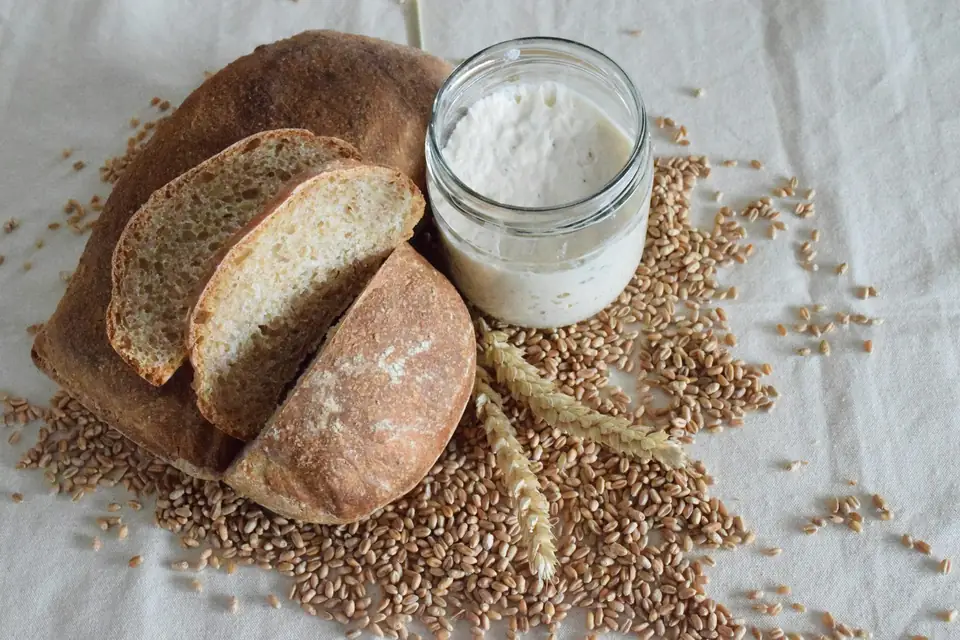
For pizza, sourdough usually means a wheat starter. In Italy it is called lievito madre, "mother yeast". Traditionally it is kept fairly stiff, though many home bakers use a liquid wheat starter. The portion you keep and feed is your starter.
Our calculator assumes a starter at 100 % hydration, meaning equal weights of flour and water. As a guide, use 8 % of the flour weight for around 24 hours of fermentation, up to 20 % for 8 to 10 hours. The AVPN permits sourdough for Verace Pizza Napoletana at less than 10 % of the flour used.
What sourdough brings:
- Flavour: gentle acidity and more depth, milky or punchy depending on how you manage it.
- Dough behaviour: acid affects the gluten. The dough can tighten, or, with too much acid, turn soft and sticky.
- Effort: the starter has to be at its peak when you need it. That means feeding, watching and planning.
Preferments: poolish and biga
A preferment is part of the recipe's flour and water mixed in advance with a little yeast and left to mature for hours before it goes into the final dough. You get extra flavour and structure without keeping a sourdough alive. King Arthur Baking describes preferments as typically maturing for 12 to 16 hours.
| Preferment | Texture | Hydration | Typical traits |
|---|---|---|---|
| Poolish | liquid, like thick pancake batter | about 100 % (equal flour and water) | nutty aroma, very extensible dough |
| Biga | stiff, shaggy to doughy | no fixed definition; pizza recipes often around 45 to 60 % | floral and aromatic, worked into the final mix |
Modernist Bread ran a revealing test: they compared preferments from 50 to 100 % hydration while keeping the total water in the dough the same. The loaves looked nearly identical and tasted only slightly different. Their takeaway: overall hydration matters, not the name of the preferment. Liquid preferments are also easier to mix in than stiff ones.
A note for purists: the AVPN rules call for a direct dough for Verace Pizza Napoletana, made without a preferment. That does not make poolish or biga pizza worse; it simply follows a different school.
Flavour and digestibility: what the evidence says
Sourdough and long fermentation come with a lot of promises, especially "easier to digest". Honestly, the picture is more mixed than the marketing suggests:
- Long fermentation and sourdough do change the dough measurably. In a pilot study published in Nutrients in 2017, long-fermented sourdough bread contained far fewer fructans, one group of FODMAPs, than the yeasted bread it was compared with.
- Even so, the 26 participants with irritable bowel syndrome did not tolerate the sourdough bread better. The authors stress that the study was small.
- The AVPN rulebook states that well-matured dough is easier to digest because enzymes break down starch and protein in advance. That is the association's view, not a study result.
Our take: long fermentation, with yeast or sourdough, makes pizza more flavourful and nicer to eat. We do not turn that into health claims. If you have digestive problems, talk to a doctor, not your pizza baker.
Which one is right for you?
| Situation | Our suggestion |
|---|---|
| First pizza, little time | instant or fresh yeast, direct dough, 8 to 12 hours at room temperature |
| Predictable and full of flavour | a little fresh yeast and 24 to 72 hours of cold fermentation |
| More flavour without starter upkeep | an overnight poolish |
| You already keep a sourdough | lievito madre at 8 to 20 % depending on timing |
| Many pizzas in a row, consistent results | baker's yeast, because it is the most predictable |
At home
Start with yeast. A small amount of fresh or dry yeast plus a long, cool fermentation already gives you lots of flavour, and you learn how your flour and dough behave. Once that feels comfortable, a poolish is the natural next step. Sourdough is worth it if you bake bread anyway or fancy a long-term project. Our guide to the perfect pizza dough shows a basic yeasted dough, and if things go wrong, try our dough troubleshooting guide.
At a market stand
At a market or festival one thing counts above all: the dough has to be ready at the right moment, ball after ball, whether it is 8 °C or 30 °C outside. The more predictable the leavening, the easier that is, which makes baker's yeast with a cold fermentation an obvious choice, because it can be planned precisely. Sourdough is possible at a stand but demands even more experience and tight temperature control.
The bottom line
Yeast versus sourdough is not about right or wrong. Baker's yeast is reliable, simple and, with a long fermentation, surprisingly flavourful. Sourdough brings depth and tang but needs care. Preferments such as poolish and biga sit in between. Time, temperature and a flour that suits your method matter more than the leavening itself; see our guide to flour types for pizza.
The timeline
Frequently asked questions
How do I convert fresh yeast to dry yeast?
Use about one third of the fresh weight for active dry yeast and one third to one quarter for instant. So 3 g of fresh yeast becomes roughly 1 g of dry.
Is sourdough pizza easier to digest?
It is often claimed but not proven. In a small pilot study, long-fermented sourdough bread did contain fewer fructans, yet people with IBS did not tolerate it better than yeasted bread.
What is the difference between poolish and biga?
Both are preferments made with commercial yeast. Poolish is liquid, with equal weights of flour and water, while biga is much stiffer. In the final dough, total hydration matters most.
Can a true Neapolitan pizza be made with sourdough?
Yes. The AVPN rules allow fresh yeast, dry yeast at a 1 to 3 ratio and sourdough at less than 10 % of the flour weight.
What should beginners use?
A small amount of fresh or dry yeast and a long, cool fermentation. It is predictable and forgiving.
Sources
- International Regulations for obtaining the collective trademark Verace Pizza Napoletana (Disciplinare 2024, English version), Associazione Verace Pizza Napoletana (AVPN) (pizzanapoletana.org)
- How do I bake with fresh yeast?, King Arthur Baking (kingarthurbaking.com)
- Baking with preferments, King Arthur Baking (kingarthurbaking.com)
- Are Biga, Poolish, and Sponge Interchangeable?, Modernist Bread (modernistbread.com)
- Pilot Study: Comparison of Sourdough Wheat Bread and Yeast-Fermented Wheat Bread in Individuals with Wheat Sensitivity and Irritable Bowel Syndrome, Nutrients (2017), via PubMed Central (pmc.ncbi.nlm.nih.gov)
We check facts against these sources. Spotted a mistake? Write to us and we will fix it.