Contents
Tomato and mozzarella are the heart of a margherita. With tomato, the usual mistake is cooking it too much; with cheese, the trouble is almost always water. A lovely pizza turns into soup because the mozzarella floods the centre. Here is what kinds of mozzarella exist, what the labels mean and how to prepare the cheese so it melts without swimming.
What mozzarella actually is
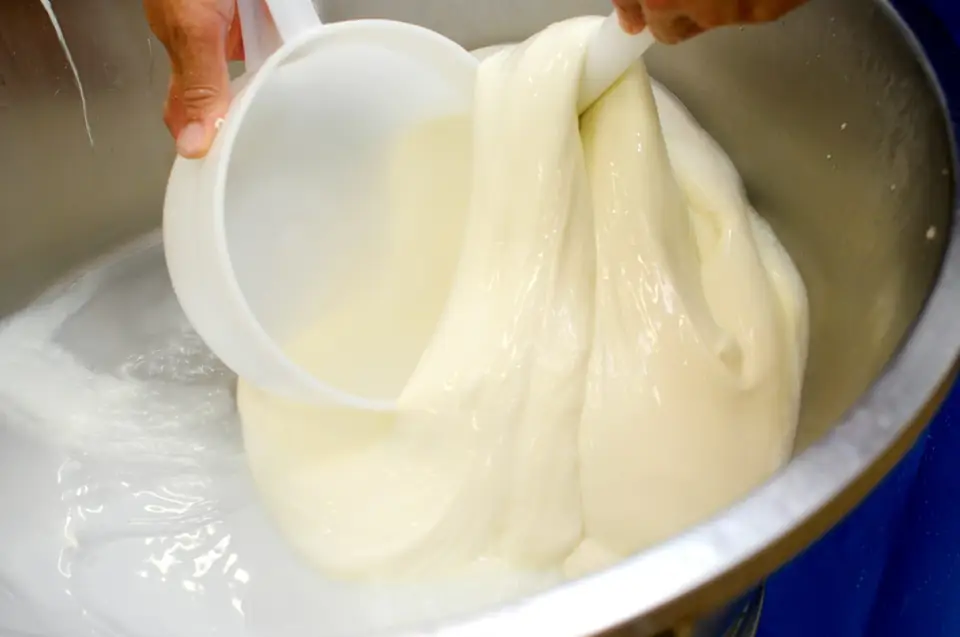
Mozzarella is a fresh stretched-curd cheese ("pasta filata"). The curd is kneaded and pulled in hot water until smooth and elastic, then shaped by hand or machine and cooled in cold water or brine. The name comes from the Italian "mozzare", to cut off, because the balls are pinched off the stretched curd. In practice, mozzarellas differ mainly by milk and by water content.
The main types
Fior di latte
In Italy, fior di latte is the everyday name for mozzarella made from cow's milk. The term itself is not protected, so quality varies widely. Good fior di latte tastes mild and milky with a light tang and melts evenly. It is the everyday standard for Neapolitan pizza, partly because it releases a little less liquid than buffalo mozzarella.
Mozzarella di Bufala Campana DOP
Mozzarella di Bufala Campana is registered as a protected designation of origin (DOP). According to its consortium, it is made from buffalo milk that is heat-treated or pasteurised and taken to the dairy very quickly, using a natural whey starter from earlier batches ("cizza") and natural calf rennet. The production area covers parts of four regions: in Campania the whole provinces of Caserta and Salerno plus parts of Naples and Benevento; in Lazio parts of the provinces of Latina, Frosinone and Rome; in Apulia part of the province of Foggia; and in Molise the municipality of Venafro.
Buffalo milk is richer in fat and protein than cow's milk, and the cheese is correspondingly rich. On pizza it tastes creamy and intense, but it releases noticeably more liquid in the oven.
Mozzarella TSG, now "Mozzarella Tradizionale"
Since 1998, mozzarella has also been registered in the EU as a Traditional Speciality Guaranteed (TSG). What is protected is not a place but a traditional method. Following an amendment in 2022 (Implementing Regulation (EU) 2022/1291), the protected name is now "Mozzarella Tradizionale". Among other things, the specification requires whole milk that arrives raw at the dairy, a natural lactic starter made from milk collected locally, liquid bovine rennet and storage at 0 to 4 °C. Balls must have a water content of 58 to 66 %. The EU specification for Pizza Napoletana TSG names Mozzarella TSG alongside Mozzarella di Bufala Campana DOP as the cheese for the pizza.
Low-moisture mozzarella ("pizza cheese")
The blocks or bags of grated cheese sold "for pizza" in supermarkets are usually mozzarella with much less water. US food law draws a clear line: regular mozzarella has 52 to 60 % moisture, "low-moisture mozzarella" 45 to 52 %. These cheeses melt evenly, stretch into long strings and brown more. For long bakes in a home oven, tray pizzas or New York style, they are often the more practical choice, though they lack the fresh milky flavour of fior di latte.
Provola and scamorza
Other stretched-curd cheeses end up on pizza too. Provola is popular in Naples, often smoked ("provola affumicata"), for example on the "provola e pepe" pizza. Scamorza is pear-shaped, firmer and drier, and is also often smoked. Both release less water than fresh mozzarella and bring a bolder, smoky aroma. Great with vegetables or cured meats, less so on a classic margherita.
Comparison at a glance
| Type | Milk | Water content | Flavour | On the pizza | Best for |
|---|---|---|---|---|---|
| Fior di latte | cow | high | mild, milky | melts evenly, moderately wet | Napoletana, margherita |
| Mozzarella di Bufala Campana DOP | buffalo | high, rich in fat | creamy, intense | releases a lot of liquid | margherita, also after baking |
| Mozzarella Tradizionale TSG | whole milk, species not specified | 58-66 % (balls) | mild, lightly tangy | like fior di latte | Napoletana |
| Low-moisture mozzarella | mostly cow | approx. 45-52 % (US definition) | mild, less fresh | browns well, stretches | trays, home ovens, New York style |
| Provola / scamorza | mostly cow | lower | bold, often smoked | dry, aromatic | vegetable and meat pizzas |
How to prepare mozzarella for pizza
Draining
Fresh mozzarella sits in brine and is full of whey inside. Great for flavour, bad for a crisp centre. What works:
- Take the mozzarella out of its liquid a few hours ahead.
- Cut it into strips or cubes.
- Let it drain in a sieve over a bowl in the fridge.
How long depends on the cheese and the oven. In a very hot oven with a short bake more water evaporates; in a home oven you need to drain more thoroughly.
Cutting
The Pizza Napoletana specification has 80 to 100 g of mozzarella laid on "a listelli", in strips. Strips or rough cubes spread more evenly than slices, and the tomato stays visible between the pieces. Tearing by hand works too and looks nicely rustic. Low-moisture mozzarella can be grated.
Amount and timing
For a Neapolitan margherita, both the TSG specification and the AVPN give 80 to 100 g of mozzarella. According to the TSG rules, it reaches about 65 to 70 °C during baking and should lie melted on the surface.
With buffalo mozzarella, not everyone does it the same way. The specifications put it on before baking, but many pizzerias add all or part of it after baking or just before the end. That keeps it creamy and lukewarm and stops it from soaking the dough. It is a question of style, not a mistake, so feel free to try both.
What else belongs on a pizza, and how much, is covered in our topping rules. For the matching tomato, see tomato sauce for pizza, and for the exact requirements of Neapolitan pizza, read the rules of Neapolitan pizza.
Storage
- Cold: The Mozzarella Tradizionale TSG specification states 0 to 4 °C, so keep mozzarella in the coldest part of your fridge.
- In its liquid: Fresh mozzarella stays in its brine until you use it so it doesn't dry out.
- Opened: Keep leftovers covered in their liquid and use them soon. The date on the pack applies to the unopened product.
- Freezing: Fresh mozzarella loses a lot of water when thawed and turns crumbly. It will do for pizza at a pinch, less so for salads.
Vegetarian?
If you avoid animal rennet, read closely. The Mozzarella Tradizionale TSG specification requires liquid bovine rennet, and the Mozzarella di Bufala Campana DOP consortium describes the use of calf rennet. Neither is vegetarian in the strict sense. Some other mozzarellas are made with microbial rennet, which will be stated on the label.
The bottom line
There is no single "right" mozzarella, only the right one for your style and oven. Fior di latte is the reliable all-rounder, buffalo the creamy treat, low-moisture mozzarella the robust option for long bakes. What they all need: good draining, cutting into pieces and a sensible amount.
The timeline
Frequently asked questions
Which mozzarella is best for pizza?
It depends on the style. Fior di latte or buffalo mozzarella are classic for Neapolitan pizza; for long bakes in a home oven or on a tray, drier low-moisture mozzarella is often more practical.
Why does my pizza go watery with mozzarella?
Fresh mozzarella contains a lot of water. Cut it into strips or cubes beforehand and let it drain in a sieve in the fridge so the centre stays drier.
When should buffalo mozzarella go on the pizza?
The Neapolitan specification puts it on before baking. Some pizzerias add all or part of it after baking so it stays creamy and releases less liquid. It is a matter of taste.
What does Mozzarella TSG mean?
TSG stands for Traditional Speciality Guaranteed. It protects a traditional method of making mozzarella, not a place of origin. Since 2022 the protected name has been Mozzarella Tradizionale.
Is mozzarella vegetarian?
Not necessarily. The rules for Mozzarella di Bufala Campana DOP and Mozzarella Tradizionale TSG call for animal rennet. For other products, check the label.
Sources
- Mozzarella di Bufala Campana DOP: Produzione, Consorzio di Tutela Mozzarella di Bufala Campana DOP (mozzarelladop.it)
- Territorio, Consorzio di Tutela Mozzarella di Bufala Campana DOP (mozzarelladop.it)
- Specification of the TSG Mozzarella Tradizionale (Gazzetta Ufficiale, 17 August 2022), Gazzetta Ufficiale della Repubblica Italiana (copy via Regione del Veneto) (elezioni2020.regione.veneto.it)
- Commission Regulation (EU) No 97/2010 (Pizza Napoletana TSG), Annex II: specification, legislation.gov.uk (The National Archives) (legislation.gov.uk)
- International Regulations Verace Pizza Napoletana (2024), Associazione Verace Pizza Napoletana (pizzanapoletana.org)
- 21 CFR 133.155 and 133.156: Mozzarella and low-moisture mozzarella cheese, U.S. Government Publishing Office (govinfo.gov)
We check facts against these sources. Spotted a mistake? Write to us and we will fix it.