Contents
- What makes a pizza style
- Campania: Naples and pizza napoletana
- Lazio: Rome and its many pizzas
- Sicily: sfincione from Palermo
- Liguria: focaccia, sardenaira and pissalandrea
- Piedmont: pizza al padellino from Turin
- Apulia: focaccia barese and panzerotto
- Lombardy: pizza al trancio in Milan
- Comparison table: Italian pizza styles at a glance
- Where does TIAMO fit in?
- The bottom line
Order "a pizza" in Italy and what lands on your plate depends entirely on where you are. In Naples it is soft, foldable and ready in just over a minute. In Rome it crackles when you bite it, or it is cut from a tray and weighed. In Palermo it stands tall like a cushion, and in Turin it arrives in its own little pan. That is exactly what makes the subject so much fun: in Italy, pizza is not a uniform product but part of each town's baking culture.
In this guide we take you on a short trip through the most important styles. We tell you what is well documented and where a story is closer to folklore. One thing up front: Italians argue passionately about what counts as "proper" pizza. We are not here to referee, just to make the differences easier to understand.
What makes a pizza style
Before we travel through the regions, it helps to know the levers. Almost every style can be described with four questions:
- Dough: Which flour, how much water, oil or no oil? The share of water in a dough is called hydration. For how a dough comes together, see our guide to pizza dough.
- Thickness and shape: round or rectangular, thin or tall, with or without a rim?
- Shaping: stretched by hand, rolled with a pin or pressed into a tray?
- Oven: straight on a hot stone floor, in a tray or in a pan, at 250 °C or close to 500 °C?
Nearly everything you taste follows from these four: crisp or soft, airy or dense, juicy or dry.
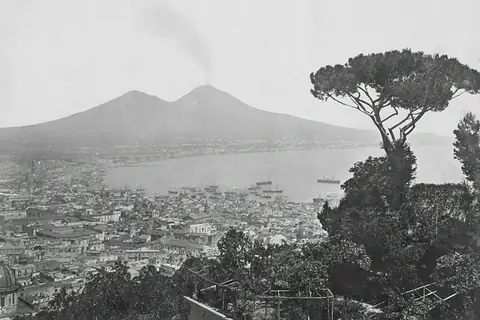
Campania: Naples and pizza napoletana
Classic Napoletana
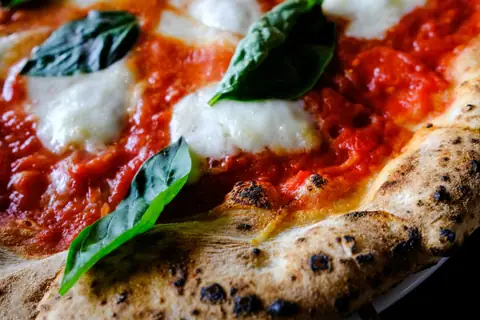
Neapolitan pizza is the most famous style in the world and the only one registered in the EU as a "Traditional Speciality Guaranteed" (TSG). The specification describes a round pizza no wider than 35 cm, with a centre about 0.4 cm thick and a raised rim, the cornicione, of 1 to 2 cm. The dough is just wheat flour, water, salt and yeast. It bakes directly on the oven floor in 60 to 90 seconds at roughly 430 to 485 °C.
The Associazione Verace Pizza Napoletana (AVPN) also publishes its own specification, used by member pizzerias around the world. It describes a pizza that is soft, fragrant and easy to fold "a libretto", like a small book. We go into the details in our article on the rules of Neapolitan pizza, and the story of how pizza took root in Naples is told in our history of pizza.
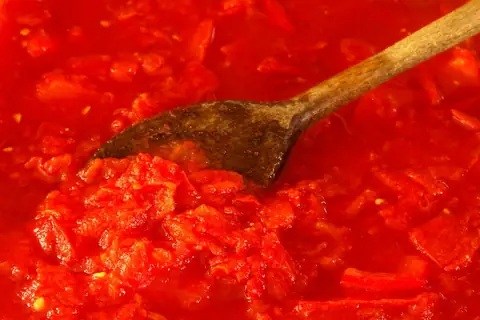
Toppings are kept simple. The marinara has tomato, garlic, oregano and olive oil; the margherita has tomato, mozzarella or fior di latte, basil and oil. What makes good tomatoes and good cheese is covered in tomato sauce for pizza and mozzarella for pizza.
Canotto and "pizza contemporanea"
Over the last few years a trend has taken off in and around Naples: pizza "canotto", named after an inflatable dinghy. It is a Neapolitan pizza with a very tall, heavily risen rim. Today many people prefer the term "pizza contemporanea". Italian food media describe how much social media pushed this look, and also the criticism: an oversized rim leaves less room for the topping. As a counter-movement, the very thin, wide "ruota di carro" (cartwheel) is popular again. In the end, quality comes down to craft, not the label.
Pizza fritta and montanara
Naples fries its pizza too. The AVPN specification lists pizza fritta as a traditional variant: the dough is stretched by hand to about 2 to 3 mm and fried at around 175 °C, either folded into a filled half-moon (calzone fritto) or as a round (tonda fritta). Among the common fried variants, the rulebook also lists the montanara, a small fried pizza with tomato, cheese and basil.
Lazio: Rome and its many pizzas
Rome has not one pizza style but several. The city's own tourism site notes that at a "pizzeria a taglio" you can choose between pizza alla pala and pizza in teglia.
Roman tonda, the "scrocchiarella"
The round Roman pizza is the opposite of the Napoletana: very thin, crisp especially at the edge, with hardly any rim. Romans fondly call it "scrocchiarella", the crunchy one. At around 55 % hydration the dough is fairly firm, and olive oil is often added. It is traditionally rolled out with a rolling pin (mattarello), though skilled pizzaioli stretch it by hand. It bakes a little longer, up to about two minutes, at a lower temperature than in Naples.
Pizza al taglio and in teglia
Al taglio means "by the cut": the pizza is baked in rectangular trays, cut into pieces and usually sold by weight. In the past this was simply bread dough in a tray. Since the 1990s the modern Roman teglia has taken over, with a very wet dough of about 75 to 90 % hydration and a long, cold maturation. The result is a light, open crumb with a crisp underside.
Pizza alla pala
Pizza alla pala is long and oval and is slid onto the hot stone on a long wooden peel. Its dough is also very soft, up to around 80 % hydration, often with a little oil. It comes "bianca", "rossa" or with mozzarella and is often sold on paper.
Pizza bianca
Pizza bianca is the simplest of all: dough, olive oil and coarse salt, nothing else. Bakeries make it and Romans eat it like bread, often filled with mortadella, which they call "mortazza". Its red sibling, pizza rossa, gets only tomato and oil.
Sicily: sfincione from Palermo
Sfincione is a tall, soft tray bake halfway between pizza and focaccia. The well-hydrated dough bakes into a spongy, airy slab. On top go onions softened in oil with tomato, anchovies, caciocavallo (a sharp stretched-curd cheese from the south), oregano and finally breadcrumbs. It is sold all year but is especially loved on Christmas Eve. The name is usually traced to the Latin "spongia", sponge.
Liguria: focaccia, sardenaira and pissalandrea
Liguria is focaccia country above all. In the far west around Sanremo, though, there is a tray bake that comes very close to pizza: sardenaira. A focaccia dough is pressed into a tray and topped with tomato, anchovies, Taggiasca olives, unpeeled garlic cloves and oregano. Its close relative with onions is called pissalandrea and is found in the province of Imperia and as far as Nice. There are several theories about the name; the most common links it to "sarda", sardine.
Piedmont: pizza al padellino from Turin
Turin has its own pizza tradition that few outsiders know: pizza al padellino. It is baked in small round pans of aluminium or iron, usually no wider than about 20 cm. The dough is pressed into the pan, often brushed with some tomato, left to rest again and then baked. The result is soft, fairly thick and almost rimless, with toppings right to the edge. Locals traditionally order farinata on the side, the thin chickpea flatbread.
You will also hear "pizza al tegamino". Turin purists insist on "padellino" and joke that a tegamino is for frying eggs. Italian food media report that Tuscan families brought the style to Turin in the 1950s.
Apulia: focaccia barese and panzerotto
In Apulia, focaccia rules. Focaccia barese is usually made with re-milled durum semolina (semola rimacinata), often with boiled potato in the dough for a moist crumb. The classic topping is halved cherry tomatoes, black olives, oregano and plenty of olive oil, and the edges turn wonderfully crisp in the tray.
The panzerotto is a half-moon of yeast dough filled with tomato and mozzarella and deep-fried. Several Apulian towns claim it, but it is most strongly associated with Bari. The name is usually traced to "panza", the round belly the filling creates.
Lombardy: pizza al trancio in Milan
Milan has its own answer to pizza by the slice: pizza al trancio, tall, soft and generous with mozzarella, cut into wedges from a large round tray. The best-known example is a Milan pizzeria that, according to the company and the press, has baked this way since 1953 and was founded by a family with Tuscan roots. Milanese trancio is less a codified style than a well-loved city habit.
Comparison table: Italian pizza styles at a glance
| Style | Region / city | Dough | Thickness | Oven | Typical hydration |
|---|---|---|---|---|---|
| Napoletana | Campania / Naples | flour, water, salt, yeast | centre approx. 0.4 cm, airy rim | stone floor, approx. 430-485 °C, 60-90 s | approx. 55-65 % |
| Canotto / contemporanea | Campania | like Napoletana, often wetter | thin centre, very tall rim | stone floor, very hot | varies, no fixed rule |
| Pizza fritta | Campania / Naples | pizza dough | 2-3 mm, filled or round | frying oil, approx. 175 °C | as pizza dough |
| Roman tonda | Lazio / Rome | often with olive oil | very thin, crisp | stone floor, up to approx. 2 min, less hot | approx. 55 % |
| Al taglio / teglia | Lazio / Rome | very wet, long cold maturation | medium to tall, airy | tray, electric oven | approx. 75-90 % |
| Alla pala | Lazio / Rome | very soft, often with oil | flat, oblong | stone floor, long wooden peel | up to approx. 80 % |
| Sfincione | Sicily / Palermo | soft, well hydrated | tall, spongy | tray | no fixed figure |
| Sardenaira | Liguria / Sanremo | focaccia dough with oil | medium | tray | no fixed figure |
| Al padellino | Piedmont / Turin | proofed in the pan | fairly thick, hardly any rim | small pan up to approx. 20 cm | no fixed figure |
| Focaccia barese | Apulia / Bari | with durum semolina, often potato | medium, crisp edge | tray | no fixed figure |
| Al trancio | Lombardy / Milan | soft, oily | tall | large tray | no fixed figure |
The hydration figures are guide values from specifications and the Italian food press. Every pizzeria has its own recipe, and tray pizzas in particular vary a lot. If you want to try a style at home, plug the numbers into our dough calculator.
Where does TIAMO fit in?
We are a small family-run pizza stand near Frankfurt, not a Neapolitan pizzeria or a Roman bakery. We serve Margherita and Salami, whole or by the slice. What we love about Italy is exactly this variety: every style has its reasons, and every one of them is made with care. Pizza con amore, in other words.
The bottom line
Italy has dozens of pizza styles, and the ones above are just the best known. Naples stands for softness and heat, Rome for crunch and pizza by the slice, the south for tall tray bakes with bold toppings, the north for pan and tray pizzas with their own history. Next time you are in Italy, don't order "the" pizza. Ask what people eat in that particular town.
The timeline
Pizza map of Italy
Tap a dot to learn about the style of that region.
Naples
Campania
Home of pizza napoletana: soft, thin centre, airy rim, 60 to 90 seconds in a very hot oven. Also the birthplace of pizza fritta and montanara.
Frequently asked questions
What is the real Italian pizza?
There isn't just one. Neapolitan pizza is the best known and is protected as a TSG in the EU, but Rome, Palermo, Turin and Bari have their own equally traditional styles.
How is Neapolitan pizza different from Roman pizza?
Neapolitan pizza has a thin, soft centre and a puffy rim and bakes in 60 to 90 seconds. Roman tonda is thin and crisp all the way through, is often rolled with a pin and bakes a little longer at a lower temperature.
What does pizza al taglio mean?
Pizza by the cut. It is baked in rectangular trays, cut into pieces and usually sold by weight. Modern Roman teglia doughs contain a lot of water.
Is pizza canotto a tradition of its own?
It is better described as a modern trend within Neapolitan pizza, marked by a very tall, airy rim. Many now call it pizza contemporanea.
What kind of pizza does TIAMO make?
At our stand you'll find Margherita and Salami, as a whole pizza or by the slice (one sixth). Come by and we'll happily tell you how we bake them.
Sources
- Disciplinare internazionale Verace Pizza Napoletana (2024), Associazione Verace Pizza Napoletana (pizzanapoletana.org)
- Production specification of the TSG Pizza Napoletana (Gazzetta Ufficiale, 9 March 2010), Gazzetta Ufficiale della Repubblica Italiana (copy via Horeca News) (horecanews.it)
- Che pizza? Uno per uno, (quasi) tutti gli stili della pizza italiana, Dissapore (dissapore.com)
- Lo street food, Turismo Roma (Roma Capitale) (turismoroma.it)
- Pizza al padellino: le 12 migliori di Torino, Dissapore (dissapore.com)
- Sfincione palermitano, la ricetta originale, Dissapore (dissapore.com)
- Sardenaira, la ricetta originale di Sanremo, Dissapore (dissapore.com)
- Pizza. Pignalosa mette la parola fine alla disfida canotto-tradizione, Scatti di Gusto (scattidigusto.it)
We check facts against these sources. Spotted a mistake? Write to us and we will fix it.