Contents
On a pizza, tomato is far more than a splash of red. It brings acidity, freshness and moisture, and it balances the mild cheese and the bready rim. It is also the ingredient people most often overdo: cooked too long, seasoned too hard, spread too thick. Here is which tomatoes work, when to leave the sauce raw and when cooking it makes sense.
Raw or cooked? The big decision
Raw sauce for Neapolitan pizza
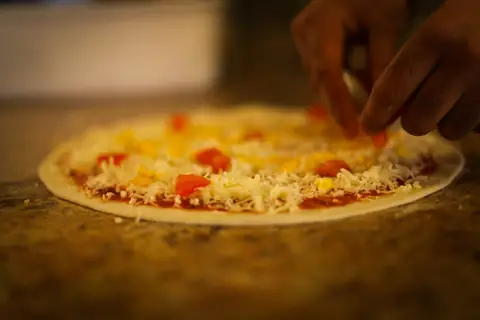
For a Napoletana, the tomato is not cooked first. The EU specification for the Pizza Napoletana TSG keeps it very simple: crushed peeled tomatoes are spooned into the centre and spread in a spiral, then salt is sprinkled over the tomato. For the versions with mozzarella, chopped fresh cherry tomatoes are allowed instead of or alongside the pelati.
The reasoning is straightforward. In 60 to 90 seconds in a very hot oven, the tomato cooks just enough. According to the TSG specification it reaches about 75 to 80 °C, loses its excess water and still tastes fresh and slightly tangy. Cook it down beforehand and it tastes like pasta sauce rather than pizza.
How to make raw pizza sauce:
- Start with good peeled tomatoes from a can or jar.
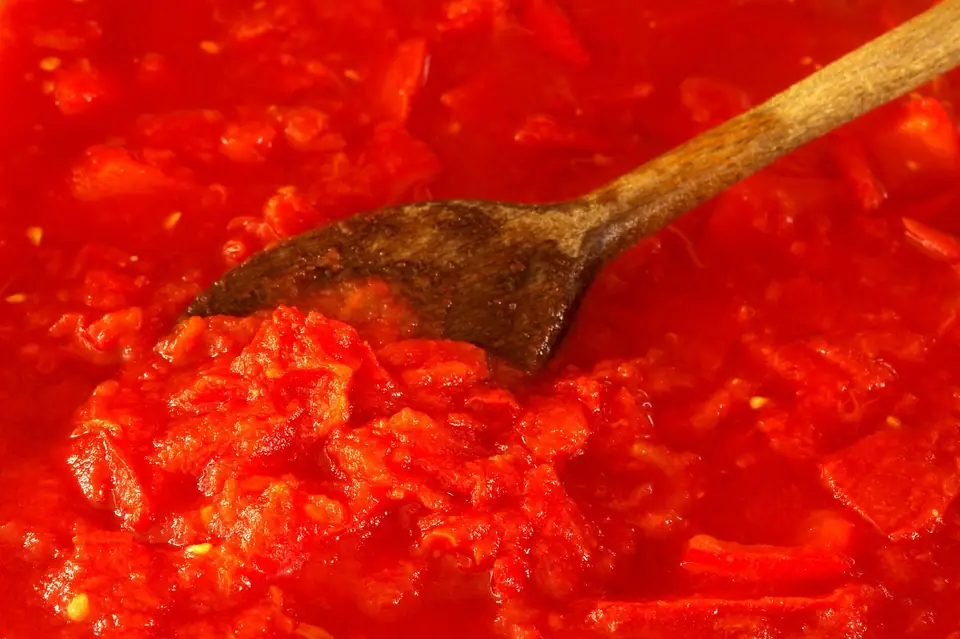
- Crush them with your hands, a fork or a food mill. A stick blender whips in air and can break up the seeds, which makes the sauce paler and sometimes bitter.
- Salt, taste, done. Drop in a few basil leaves if you like.
When a cooked sauce makes sense
Cooked sauces still have their place. Tray pizzas that spend much longer in the oven, or regional styles like Sicilian sfincione, call for a reduced sauce, in the case of sfincione even with slowly softened onions. If your tomatoes are very watery, a short simmer also helps keep the base from going soggy. For an overview of the styles, see pizza in Italy.
Pelati, passata, polpa: what's the difference?
| Product | What it is | Texture | Use on pizza |
|---|---|---|---|
| Pelati | whole peeled tomatoes in their own juice | chunky, slightly rough once crushed | the classic for Neapolitan pizza |
| Pelati a filetti | peeled tomatoes cut into lengthwise strips | chunky | good, similar to pelati |
| Polpa | chopped tomatoes | coarse pieces in juice | good, may need a short drain |
| Passata | sieved tomato purée without skins or seeds | smooth, often runny | works, less texture |
| Fresh cherry tomatoes | halved or quartered | juicy, fresh | as a topping, or on a margherita as the TSG allows |
Pelati are the first choice for many pizzaioli because you control the texture yourself. Passata is convenient but spreads thinner and can taste a little cooked, since it is heated during production. With polpa, check how much liquid is in the can; some are very watery.
Protected tomatoes from Campania
Pomodoro San Marzano dell'Agro Sarnese-Nocerino DOP
You will see "San Marzano" on plenty of cans, but only one name is protected: Pomodoro San Marzano dell'Agro Sarnese-Nocerino DOP. According to its production rules, the name applies only to peeled tomatoes, either whole ("interi") or in lengthwise strips ("a filetti"). There is no passata or polpa sold under this DOP name.
Key points from the specification:
- Varieties: S. Marzano 2 and Kiros, or lines improved from them.
- Area: listed municipalities of the Agro Sarnese-Nocerino in the provinces of Salerno, Avellino and Naples.
- Harvest: by hand only, picked in stages as the fruit ripens.
- Fruit: elongated, typically 60 to 80 mm long.
- Allowed in the can: salt up to 3 % of net weight, basil leaves and tomato juice from the same varieties and area.
According to the specification, the label of the genuine product must show, among other things, the full name, the EU symbol, "Denominazione di Origine Protetta" or DOP, the designation's own logo and the harvest year. Additions such as "extra" or "tipo" are banned from the protected name. Since an amendment in 2019 (Implementing Regulation (EU) 2019/1346), the official name spells out "San Marzano" instead of "S. Marzano". Whether the taste is worth the extra cost is your call. You don't need San Marzano DOP for a great pizza: the TSG specification doesn't require it, and the AVPN also accepts other long peeled tomatoes, preferably Italian.
Pomodorino del Piennolo del Vesuvio DOP
The second protected tomato from around Naples is Pomodorino del Piennolo del Vesuvio DOP: small, slightly pointed tomatoes with thick skins, grown on the slopes of Vesuvius in the province of Naples. The specification lists several old local types and requires hand picking. They are sold fresh or "al piennolo": the clusters are tied on a string into large hanging bunches of 1 to 5 kg that keep through the winter. Traditionally they are also preserved halved and unpeeled in jars. On pizza they bring sweetness and a pleasant acidity, often as a topping rather than a smooth sauce.
Salt, basil and oregano
Salt: The TSG specification gives no gram figure; it simply has you sprinkle salt over the tomato. As a rule of thumb for a prepared sauce, start at about 1 to 2 % of the tomato weight, so 10 to 20 g per kilo, and adjust to taste. Remember that many canned tomatoes are already salted, so taste before you add any.
Basil: Fresh basil belongs on a margherita. Add it before baking if you like it lightly toasted, or afterwards if you want it fully fresh. You can also let a few leaves steep in the sauce.
Oregano and garlic: These belong on the marinara. The AVPN specification calls for a pinch of oregano (about 0.5 g) and one sliced garlic clove (about 3 g) per pizza. Oregano traditionally has no place on a margherita.
Olive oil: A drizzle of extra virgin olive oil goes on the topped pizza, not into the sauce. The TSG specification gives 4 to 5 g for a marinara, the AVPN 6 to 8 g. For a margherita it is 4 to 5 g (TSG) or 6 to 7 g (AVPN).
Quantities per pizza
| Pizza | Tomato | Oil | Other | Source |
|---|---|---|---|---|
| Marinara | 70-100 g crushed pelati | 4-8 g | 1 garlic clove, pinch of oregano | TSG / AVPN |
| Margherita | 60-80 g pelati or cherry tomatoes | 4-7 g | 80-100 g mozzarella, basil | TSG / AVPN |
| Heavily topped pizza | around 50-70 g | as needed | less sauce so nothing goes soggy | rule of thumb |
These amounts are for a Neapolitan pizza of around 30 cm. The more topping you add, the less sauce you need. For more on balance, read our topping rules, and for the cheese that partners the tomato, see mozzarella for pizza.
Storage and hygiene
Raw tomato sauce is a fresh food. A few rules help:
- Don't leave it in the can: Germany's consumer advice centre recommends using the contents right after opening or moving them into a lidded container such as a glass jar, because opening can damage the can's inner coating.
- Keep it cold: Opened sauce belongs in the fridge and should be used quickly, ideally within a few days.
- Work cleanly: Always use a clean spoon, and keep fingers and bits of dough out of the sauce.
- Throw out bulging cans: According to the same source, cans that are badly dented outward or swollen should go straight in the bin.
- At a stand or event: Keep the sauce chilled and bring only small amounts into the work area at a time.
The bottom line
Good pizza sauce takes almost no work: good peeled tomatoes, crushed, salted and spread raw on the dough. If you want to try San Marzano DOP or Piennolo, you can spot the genuine article by the seal and the full name. And less is more: a thin layer of tomato tastes more intense than a thick one.
The timeline
Frequently asked questions
Does pizza sauce need to be cooked?
No. For Neapolitan pizza, peeled tomatoes are crushed raw and only salted. They cook in the oven, which keeps the flavour fresh.
How much sauce goes on one pizza?
The Neapolitan specifications call for 60 to 80 g on a margherita and 70 to 100 g on a marinara. Too much sauce makes the centre soggy.
Are San Marzano tomatoes always DOP?
No. Only Pomodoro San Marzano dell'Agro Sarnese-Nocerino DOP is protected, and it is sold only as peeled tomatoes, whole or in fillets. Look for the DOP seal and the full name.
Passata or pelati, which is better for pizza?
Pelati give more texture and a fresher taste and are the classic choice for Neapolitan pizza. Passata is smoother and often thinner; it works but spreads differently.
How long does opened tomato sauce keep?
Move leftovers out of the can straight away into a clean lidded container, keep them in the fridge and use them up quickly, ideally within a few days.
Sources
- Commission Regulation (EU) No 97/2010 (Pizza Napoletana TSG), Annex II: specification, legislation.gov.uk (The National Archives) (legislation.gov.uk)
- International Regulations Verace Pizza Napoletana (2024), Associazione Verace Pizza Napoletana (pizzanapoletana.org)
- Production specification Pomodoro San Marzano dell'Agro Sarnese-Nocerino DOP, Consorzio di Tutela del Pomodoro San Marzano dell'Agro Sarnese-Nocerino DOP (consorziopomodorosanmarzanodop.it)
- Production specification Pomodorino del Piennolo del Vesuvio DOP, Italia a Tavola (copy of the disciplinare) (italiaatavola.net)
- Konserven: Alles zu Haltbarkeit und Lagerung, Verbraucherzentrale (German consumer advice centre) (verbraucherzentrale.de)
We check facts against these sources. Spotted a mistake? Write to us and we will fix it.