Contents
"Authentic Neapolitan pizza" appears on countless menus. But what does it actually mean? There is not one label behind it but three very different things that often get mixed up: an EU quality label (TSG), a private association from Naples (AVPN) and a UNESCO listing. Let's untangle them, with the real numbers from the original documents.
Three layers at a glance
| TSG "Pizza Napoletana" | AVPN | UNESCO | |
|---|---|---|---|
| What is it? | EU quality scheme "Traditional Speciality Guaranteed" | Private association based in Naples | Entry on the intangible cultural heritage list |
| Since when? | Regulation (EU) No 97/2010 of 4 February 2010 | Founded 1984 | 2017 |
| What is protected or honoured? | A precisely described production method | The "Vera Pizza Napoletana" mark and its own rulebook | The craft of the pizzaiuoli, not the product |
| Tied to Naples? | No, valid wherever the rules are followed | No, member pizzerias worldwide | Yes, the practice in Naples |
| Who checks? | Approved inspection bodies | The association itself | Nobody, it is not a certification |
The TSG label: EU law for a pizza
On 4 February 2010 the European Commission entered the name "Pizza Napoletana" in the register of traditional specialities guaranteed with Regulation (EU) No 97/2010. In Italian that is STG, "Specialità Tradizionale Garantita".
It helps to understand that a TSG is not the same as a protected designation of origin like Parmigiano Reggiano. The European Commission describes the TSG as highlighting traditional aspects such as how a product is made or its composition, without a link to a specific geographical area. So a Pizza Napoletana TSG can be baked in Frankfurt or Manchester, provided it is made exactly according to the specification and the business is inspected.
A small side note: the AVPN's own timeline dates TSG recognition to 2004, which presumably refers to the procedure under way at the time. The name was legally registered at EU level by the 2010 regulation.
What the specification requires
The product specification annexed to the regulation is remarkably detailed. The key points:
| Area | TSG specification |
|---|---|
| Flour | Soft wheat flour, W value 220-380, protein 11-12.5 % |
| Other basic ingredients | Drinking water, sea or table salt, brewer's yeast, peeled and/or small fresh tomatoes, extra virgin olive oil |
| Dough quantities | Per 1 litre of water, 50-55 g sea salt, 3 g brewer's yeast and about 1.8 kg flour, added gradually up to the "dough point" |
| Kneading | About 10 minutes to the dough point, then 20 minutes at low speed |
| First rise | 2 hours on the work surface, covered with a damp cloth |
| Dough balls | 180-250 g, shaped by hand only |
| Second rise | 4-6 hours in containers at room temperature, then use within 6 hours |
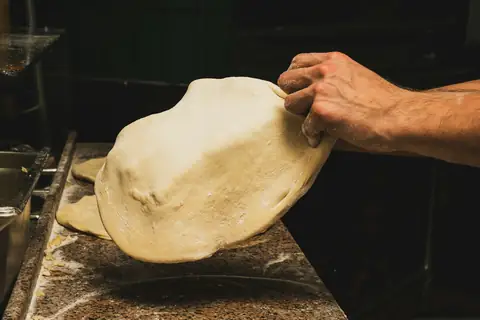
| Shaping | By hand only, from the centre outwards, no rolling pin, no dough press |
| Centre | 0.4 cm thick (± 10 %) |
| Rim (cornicione) | 1-2 cm |
| Diameter | 35 cm maximum |
| Oven | Wood-fired only |
| Temperature | Oven floor about 485 °C, dome about 430 °C (the AVPN assigns them the other way round, see below) |
| Baking time | 60-90 seconds |
| Result | Soft, elastic, easy to fold into four |
A few details stand out. The specification requires all steps to be carried out in one continuous cycle on the same premises, so no ready-made dough balls from a wholesaler. It even states the temperatures the ingredients reach in the oven, for instance 60-65 °C in the dough and 65-70 °C in the mozzarella.
If you want the basics for your own dough, see our guide to pizza dough. The airy cornicione only comes with a very hot oven and gentle stretching by hand.
Marinara and Margherita: the three permitted toppings
The TSG knows no Hawaiian and no Quattro Stagioni. It describes exactly three toppings:
- Marinara: 70-100 g crushed peeled tomatoes, salt, oregano, a thinly sliced garlic clove and 4-5 g extra virgin olive oil. No cheese.
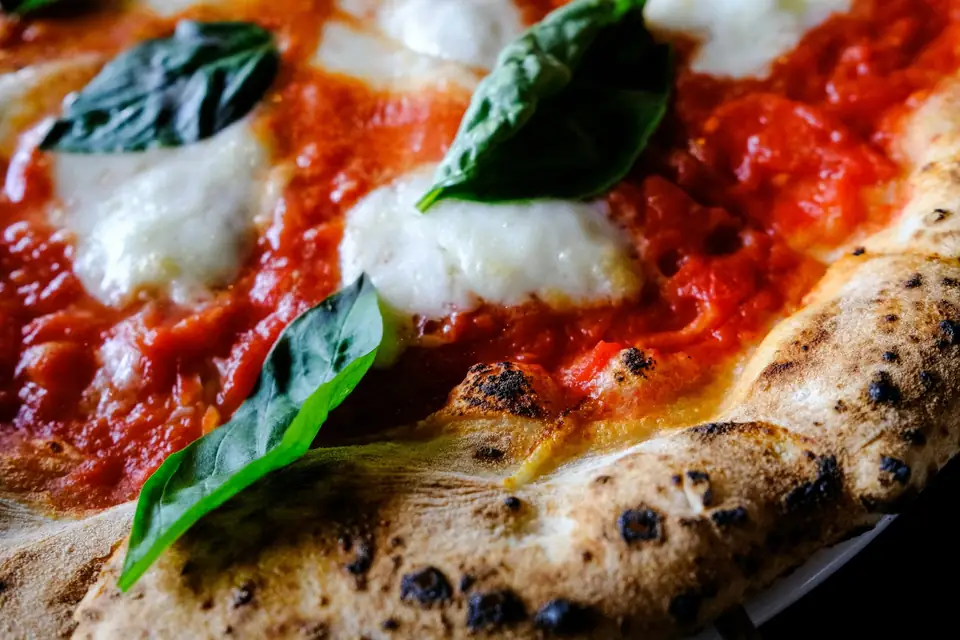
- Margherita with buffalo mozzarella: 60-80 g crushed peeled and/or chopped small fresh tomatoes, salt, 80-100 g "Mozzarella di Bufala Campana" (protected designation of origin), fresh basil, 4-5 g olive oil.
- Margherita with Mozzarella TSG: as above, but with 80-100 g "Mozzarella STG" instead of buffalo mozzarella.
So when people speak of a "Margherita STG", they mean a Pizza Napoletana TSG with one of the two Margherita toppings. There is no separate label for the Margherita alone. Notably, fior di latte (cow's milk mozzarella) is not mentioned in the TSG specification. More on the different cheeses in mozzarella for pizza.
The AVPN: the association of true pizza
The Associazione Verace Pizza Napoletana was founded in Naples in 1984, by its own account by seventeen pizza makers, and dates its first rulebook to 14 June 1984. It is a private association, not a public authority. Its aim is to promote and protect "verace pizza napoletana" in Italy and around the world, and for that it has its own rulebook, the "Disciplinare", and the collective trade mark "Verace Pizza Napoletana" (also "Vera Pizza Napoletana").
What AVPN membership means
Pizzerias around the world can apply to join the AVPN. According to the Disciplinare, the board decides after administrative and technical checks, and the association says it carries out regular inspections of its members. Members appear in the directory of associated pizzerias on the association's website. Membership tells you that a pizzeria works to the AVPN's rulebook. It is not a government label and not the same as a TSG inspection. The AVPN also runs training courses and keeps a register of trained pizzaioli.
Where the AVPN rules differ from the TSG
The AVPN rulebook is close to the TSG but more open on several points. The main differences, based on the 2024 English edition of the Disciplinare:
| Point | TSG (EU) | AVPN Disciplinare 2024 |
|---|---|---|
| Flour | Soft wheat flour, W 220-380, about 1.8 kg per litre of water | Type 00 or 0, 1.6-1.8 kg per litre of water |
| Salt | 50-55 g per litre of water | 40-60 g per litre of water |
| Leavening | Brewer's yeast, 3 g per litre of water | Fresh yeast 0.1-3 g per litre, dry yeast (one third of the fresh amount) or sourdough below 10 % of the flour, see lievito madre |
| Fermentation | 2 h + 4-6 h | 12-24 hours in total |
| Dough ball | 180-250 g | 200-280 g, depending on diameter |
| Diameter | 35 cm maximum | 22-35 cm |
| Centre | 0.4 cm | 0.25-0.3 cm |
| Mozzarella | Buffalo mozzarella PDO or Mozzarella TSG | Buffalo mozzarella or fior di latte |
| Oven | Wood-fired only | Traditionally wood, gas or electric possible if the model is certified by the AVPN |
| Floor temperature | About 485 °C | About 380-430 °C |
| Dome temperature | About 430 °C | About 485 °C |
| Baking time | 60-90 seconds | 60-90 seconds |
The longer fermentation, the permitted fior di latte and the opening to other oven types make the AVPN rulebook easier to apply day to day than the rigid EU specification. For gas or electric ovens, however, the AVPN marks the certification separately.
Floor or dome: the temperature swap
One detail causes a lot of confusion: the TSG and the AVPN use the same two figures but assign them the opposite way round. The EU specification calls for about 485 °C on the oven floor and about 430 °C in the dome. The 2024 AVPN Disciplinare instead gives about 380 to 430 °C for the floor and about 485 °C for the dome.
Neither text explains the different split. The recipe page on the AVPN website also still shows some older figures, such as 430 to 480 °C without a split and 8 to 24 hours of fermentation. For AVPN pizzerias, the current Disciplinare is what counts.
For everyday purposes a simple rule of thumb will do: Neapolitan pizza needs an oven at roughly 430 to 485 °C and bakes in 60 to 90 seconds. Which figure applies to the floor and which to the dome depends on the rulebook you follow.
UNESCO: the heritage is the craft, not the pizza
In 2017 UNESCO inscribed the "Art of Neapolitan 'Pizzaiuolo'" on the Representative List of the Intangible Cultural Heritage of Humanity. This is often shortened to "pizza is world heritage", which is not quite right.
What is recognised is a culinary practice in Naples: preparing the dough and baking it in a wood-fired oven, with the pizzaiuolo's characteristic rotating movement. According to UNESCO, around 3,000 pizzaiuoli live and work in Naples, and the know-how is passed on mainly in the "bottega", where apprentices watch the masters at work. UNESCO also highlights the social side: people coming together and sharing across generations.
There is no UNESCO label for pizzerias and no UNESCO inspection. Anyone advertising a "UNESCO pizza" is pointing to the craft, not to a certified product.
What this means for you
- If a menu says "Pizza Napoletana STG/TSG", the pizza should be made exactly to the EU specification, in a wood-fired oven, with the prescribed ingredients.
- If a pizzeria is an AVPN member, it works to the association's rulebook. You can check this in the directory on the AVPN website.
- "Neapolitan" on its own describes a style. Plenty of excellent pizzerias bake Neapolitan-style pizza without TSG or AVPN.
The story behind it all, from 18th-century street food to today's labels, is told in our history of pizza. How different pizza looks in Rome, Palermo or Turin is shown in pizza in Italy.
The timeline
Frequently asked questions
What does TSG mean for Pizza Napoletana?
TSG stands for Traditional Speciality Guaranteed, STG in Italian. The EU label protects a traditional way of making a product, not a place of origin.
Can a Pizza Napoletana TSG be made outside Naples?
Yes. Because the TSG is tied to the method and not to Naples, any business that follows the specification and is inspected can make it, anywhere.
How hot does the oven need to be?
The EU specification gives about 485 °C on the oven floor and about 430 °C in the dome of a wood-fired oven, while the AVPN puts it the other way round with about 380 to 430 °C on the floor and about 485 °C in the dome. Both agree on a baking time of 60 to 90 seconds.
Is an AVPN pizzeria the same as a TSG pizza?
No. The AVPN is a private association with its own rulebook and membership, while the TSG is an EU quality scheme. The rules are similar but not identical.
Which pizzas does the TSG cover?
The specification describes three toppings, the Marinara with tomato, garlic and oregano, and two Margherita versions with Mozzarella di Bufala Campana or Mozzarella TSG.
Sources
- Commission Regulation (EU) No 97/2010 - "Pizza Napoletana" (TSG), EUR-Lex, European Union (eur-lex.europa.eu)
- Regulation (EU) No 97/2010, Annex II (product specification), legislation.gov.uk (legislation.gov.uk)
- Geographical indications and quality schemes explained, European Commission (agriculture.ec.europa.eu)
- AVPN International Regulations (Il Disciplinare), 2024 edition, Associazione Verace Pizza Napoletana (pizzanapoletana.org)
- Storia AVPN, Associazione Verace Pizza Napoletana (pizzanapoletana.org)
- Art of Neapolitan 'Pizzaiuolo', UNESCO Intangible Cultural Heritage (ich.unesco.org)
We check facts against these sources. Spotted a mistake? Write to us and we will fix it.